
Home
Account setting
Staff
Lists
Forms
Templates (HTML emails/SMS messages)
Sending messages by SMS and email
Classes, events, attendance and Zoom
Automation
Create a birthday invitation and automation
Communication
Microsite
E-Commerce
Networks, Federations and Franchises
How to guides
Personal information and electronic message laws in Canada and the USA
Get support
Terms and conditions
RL-24
https://activitymessenger.com/
10410 Waverly, Montréal, H3L 2W4
Terms and conditions

Membership
# Add-ons, communications, and member profile
- Add-ons defines optional items sold with the membership. Add-ons can have their own price, taxes, ledger code, and card visibility.
- Communication selects the purchase-confirmation and credit-card-error email templates.
- Member profile adds form questions to collect required member information.
- Translations provides the client-facing membership content in the organization's other language.
Memberships combine a validity period, price, benefits, member records, and optional cards. Use them for a season pass, recurring subscription, permanent credential, member pricing, booking access, or a multi-visit coupon pass.
# Before you begin
Owners and administrators can create and modify memberships. From the main menu, go to E-Commerce → Memberships.
There are two related records:
- A membership is the definition offered to clients: duration, price, benefits, card, coupon rules, and communications.
- A member is an issued instance created by a purchase or manual assignment. It has its own activation and expiration dates, status, invoice, coupon balance, and card.
Changing a membership definition affects future issuance. Open an existing member when you need to change that person's dates, status, notes, or coupon balance.
# Choose Membership or Coupon pass
Open the + menu on the Memberships page:
- Choose Membership for a fixed season, rolling duration, subscription, permanent credential, member price, or booking benefit.
- Choose Coupon pass for a multi-visit card. It presets Non-expiring, turns on the membership card, and turns on Standard coupons.
- If Amilia is connected, Import brings in available external membership definitions.
The Coupon pass preset intentionally leaves Allow access outside classes and bookings off. It also selects standard coupons rather than access-control coupons.
# Configure the Information tab
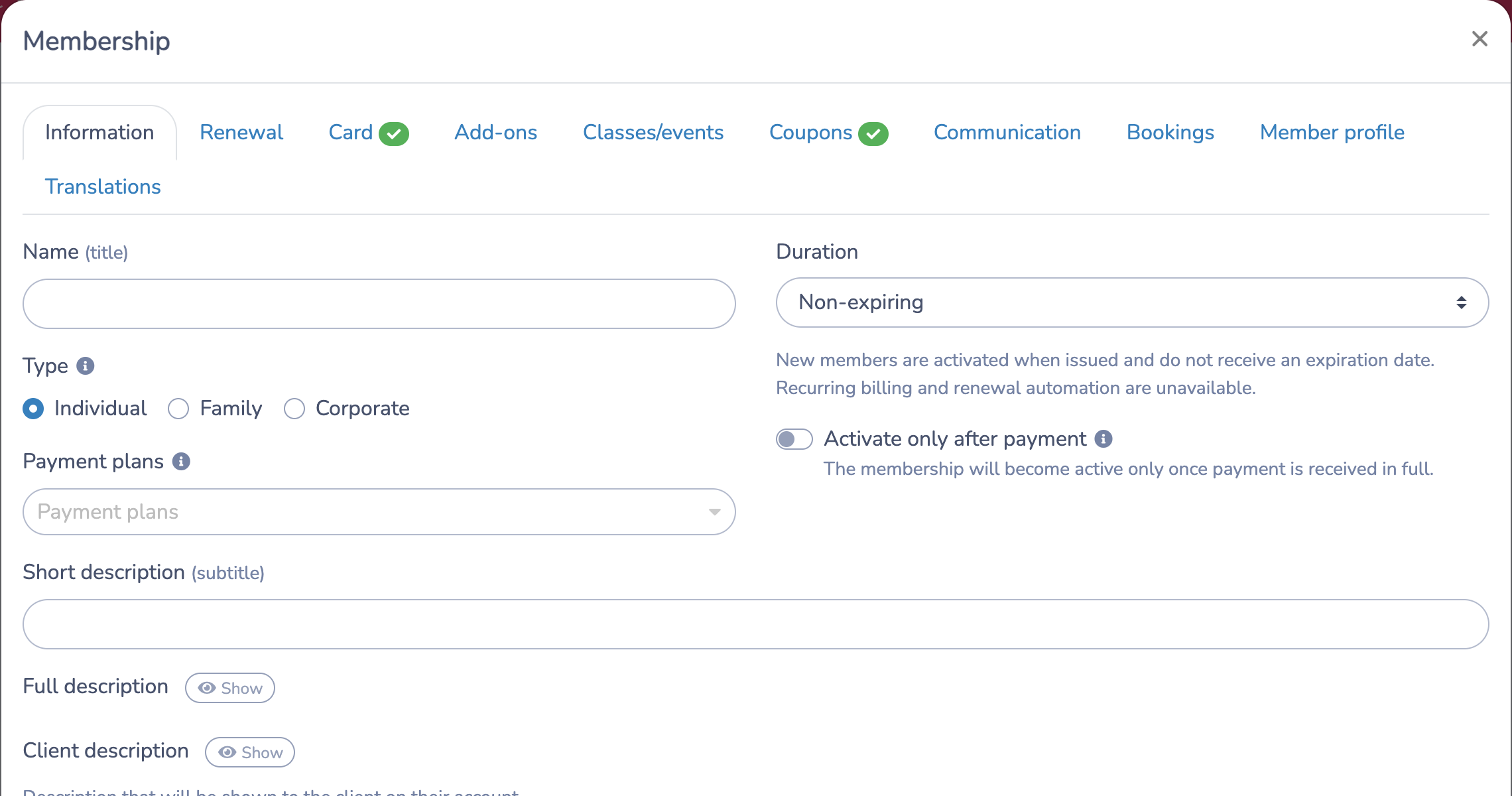
Enter the name and select the membership type:
- Individual belongs to one person.
- Family can cover members of the same family account.
- Corporate can cover members associated with the corporation.
Choose the duration that matches the service:
- Days or Months creates a rolling period from each member's activation.
- Fixed gives every member the same start and end dates, such as a season from September through May.
- Non-expiring activates the member when issued and leaves the expiration date empty.
Non-expiring memberships are one-time purchases. Recurring billing and renewal automation are unavailable. You can still offer an ordinary financing or installment plan.
Use Activate only after payment when the member should remain pending until the invoice is paid in full. A configured future start date still prevents early activation.
Complete the price, taxes, ledger code, descriptions, and image. You can also configure participant-based dynamic pricing and prices that begin on a future activation date.
# Prorate a fixed-period membership
Use a prorated price when every member shares the same end date, but clients may join after the period begins. For example, an annual membership may run from July 1 to June 30 even when a client purchases it later in the year.
- Create or open the membership and set Duration to Fixed.
- Enter the common start and end dates and the full price, then save the membership.
- Add the membership to a payment form.
- On the form's Form tab, edit the Membership question.
- Enable Pro-rata price, save the question, and preview the form.
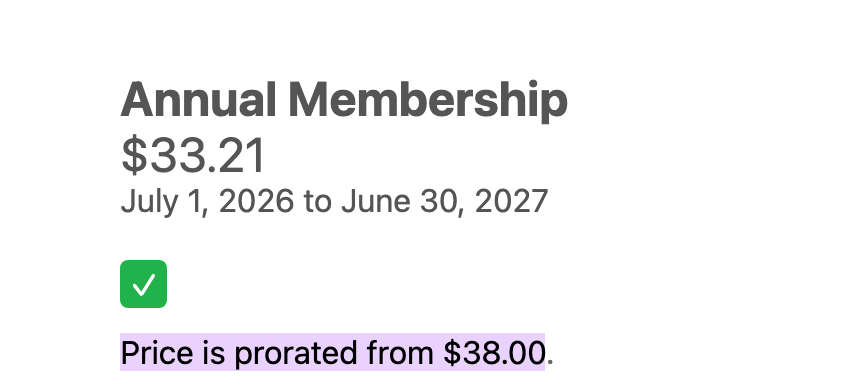
Activity Messenger calculates the amount before taxes with this formula:
prorated price = full price × remaining calendar days ÷ total calendar days
The purchase day and the membership end date are both included. A purchase before or on the fixed start date is charged the full price. After the start date, the price decreases daily until the end date.
The Pro-rata price setting belongs to the Membership question in that payment form. Enable it separately in every form where the prorated price should be offered. It does not change the price stored on the membership.
For a $38 membership from July 1 to June 30 in a 365-day period, a purchase on July 3 is $37.79 before taxes: $38 × 363 remaining days ÷ 365 total days. A purchase on September 9 is $30.71 before taxes. When renewal automation is enabled, renewal follows the issued member's June 30 expiration date and charges the full applicable membership price; the original prorated reduction is not carried into the renewal.
# Recurring billing versus renewal
These options solve different needs:
- Recurring billing continues the same rolling subscription. Configure the billing interval, billing day, number of cycles, prorating, forced start/end dates, pause behavior, and whether the client may cancel.
- Renewal automation prepares a new membership period near the end of a finite membership. It can send a confirmation email, use a contract form, and optionally collect payment for the renewal.
Do not configure both workflows for the same purpose. Renewal is unavailable for a recurring or non-expiring membership.
When renewal is enabled, review the lead time and simulator before running it. Renewal can generate future invoices and member records, so save and verify the settings before using Run renewals now.
# Create a standard coupon pass
A standard coupon is redeemed against selected classes, class tags, booking packages, or products.
- Choose + Coupon pass.
- Enter the name and price on Information.
- Open Coupons and set Number of coupons to create.
- Keep Standard coupons active.
- Select at least one eligible class, class tag, package, or product. The membership cannot be saved without an eligible resource.
- Optionally configure the coupon's expiry in days, client cancellation/refund window, automatic checkout application, drop-in-only restriction, or admin-only redemption.
- Review the Card tab and save the membership.
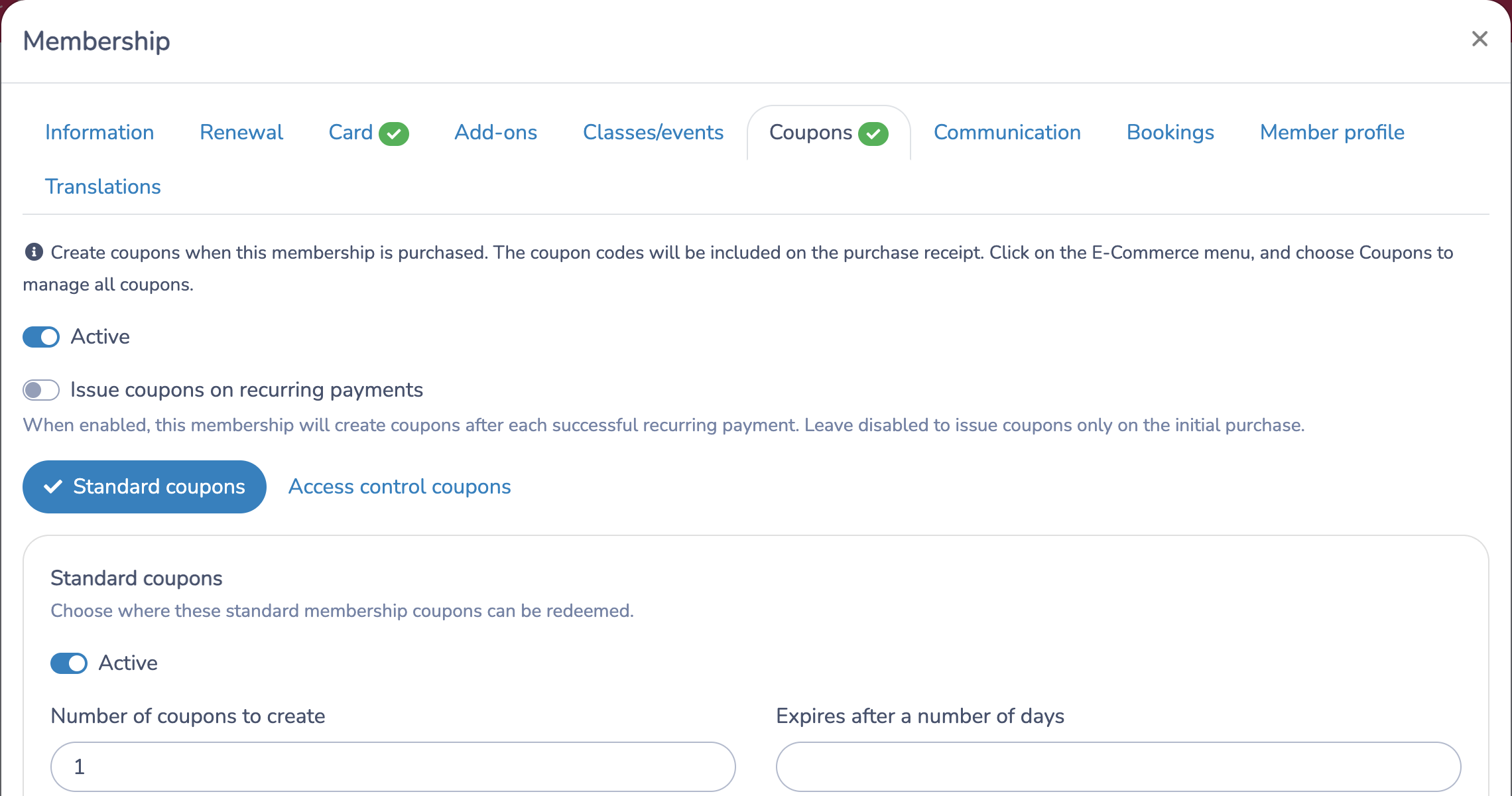
The membership expiration and coupon expiration are separate. A non-expiring membership may issue coupons that expire after a configured number of days.
By default, coupons are issued on the initial purchase. Enable Issue coupons on recurring payments only when every successful recurring payment should create another set.
# Use access-control coupons
Choose Access control coupons when one coupon should be consumed by a successful access-control scan.
Configure the number of coupons, optional coupon expiration, admin-only redemption, and the access schedule. This coupon type does not require an eligible class, package, or product because its resource is the access-control workflow.
Keep the distinction clear:
- Standard coupons are normally applied during checkout or redeemed by an administrator.
- Access-control coupons are consumed by a successful scan.
- Allow access outside classes and bookings grants general access based on the membership itself; it is not required for an access-control coupon.
# Configure membership cards and wallets
Turn on Membership card to give members:
- A virtual card in the Client account.
- Apple Wallet and Google Wallet passes.
- A printable physical card.
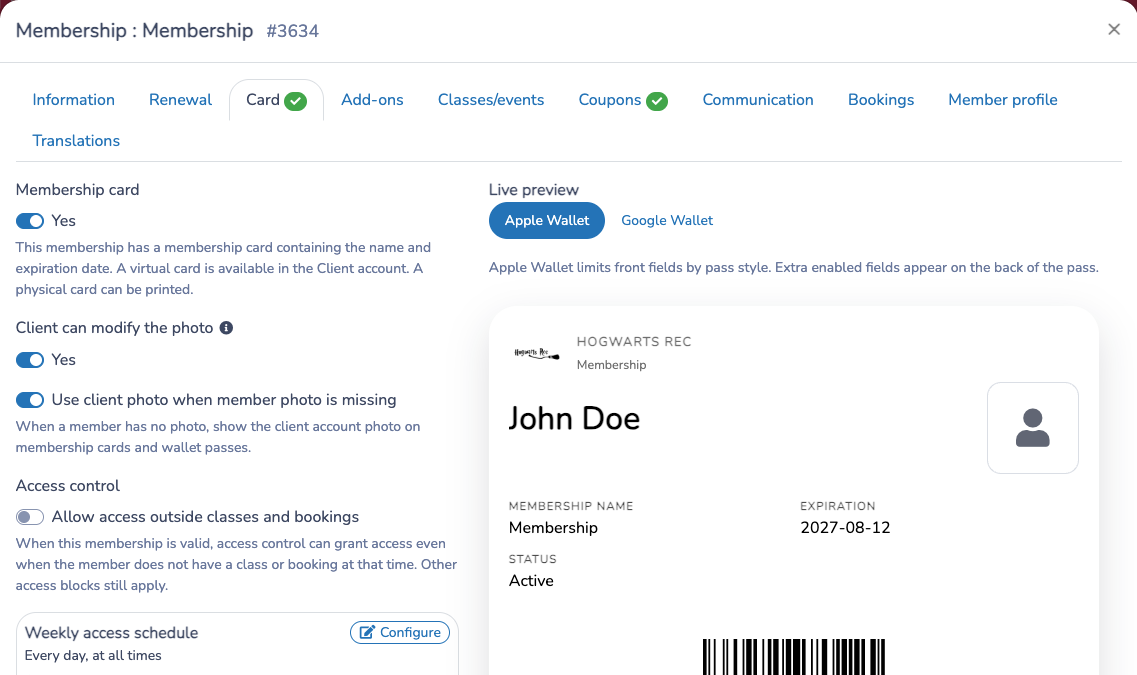
The Card tab also controls whether the client can change the photo, whether the card can use a client profile photo when the member has no photo, the wallet template, general access outside classes/bookings, the weekly access schedule, and whether access control should ignore the membership.
Enabling a card does not grant access by itself. Leave Allow access outside classes and bookings off when access should come only from a linked class, booking, or access-control coupon.
Use client profile photos on membership cards
When Use client photo when member photo is missing is enabled, Activity Messenger fills an empty member photo on membership cards and wallet passes from the client profile when possible.
The photo source follows this order:
- The member's own photo.
- A matching account member or child photo from the client profile.
- The client or account-owner photo, only when the member is not matched to a separate account member.
- The default placeholder icon.
For family memberships, the best match is the account member's student ID. If a student ID is not available, Activity Messenger only uses a profile member photo when the name and email match. This helps avoid showing the wrong child photo. When a member is matched to a separate account member but that person has no photo, the card shows the placeholder instead of falling back to the account-owner photo.
In the member window, administrators see a note when the preview is using a client profile photo instead of the member's own photo. The member record is not changed; the client profile photo is only used for display on cards and wallet passes.
For an issued member, physical and wallet cards reflect the current status, activation/expiration dates, and remaining coupon count. A non-expiring card displays No expiration and does not receive an artificial wallet expiration date.
# Link classes, events, and bookings
Use Classes/events to link specific classes or class tags.
For each link, you can:
- Require a valid membership to register.
- Offer a member price without making the membership mandatory.
- Add issued members to class attendance.
- Carry participants over when configured.
Eligibility is checked against the issued member's active interval. A member with no expiration remains time-eligible for future events, but their status and other access rules still apply.
Use Bookings to link booking packages unlocked or discounted by the membership.
# Sell a membership during class registration
A class registration form can add a membership as part of the class purchase. This is useful when a participant must become a member to register, or when you want to offer a membership and the class in one checkout. You do not need to add a separate Membership question for this workflow.
- Create the membership, then link it to the class from the membership's Classes/events tab or the class's Memberships tab. Configure whether the membership is required and, if applicable, enter the member price for the class.
- Open the registration form and edit its Class or Multiple classes question.
- Under Participant rules, enable Different participant, then enable Membership.
- To charge for a specific membership when the participant does not already have it, enable Charge the participant for the membership if he doesn't have it and select the accepted membership or memberships.
- Alternatively, enable Add one membership when participant has none of those memberships. Select the memberships that already satisfy the rule, then choose the membership to add. You can offer several memberships and let the client choose one.
- If a membership bought in this checkout should immediately unlock the linked class price, open the class question's pricing rules, enable Apply linked membership rules and prices, then enable Apply member price when membership is purchased on this form.
- Save and preview the form to verify the membership choice, class price, participant, and checkout total.
The class and membership are added as separate items on the same invoice, and the membership is issued to the participant collected by the class question. Activity Messenger does not bill an accepted membership again when the participant already has it. Enable the option that checks whether the membership expires before the class when an otherwise-current membership must remain valid through the class dates.
This class-purchase workflow is different from adding a standalone Membership question to the form. Use the standalone question when clients should simply choose and buy memberships; use the class question's participant rules when the membership purchase depends on registration for that class.
# Configure membership add-ons
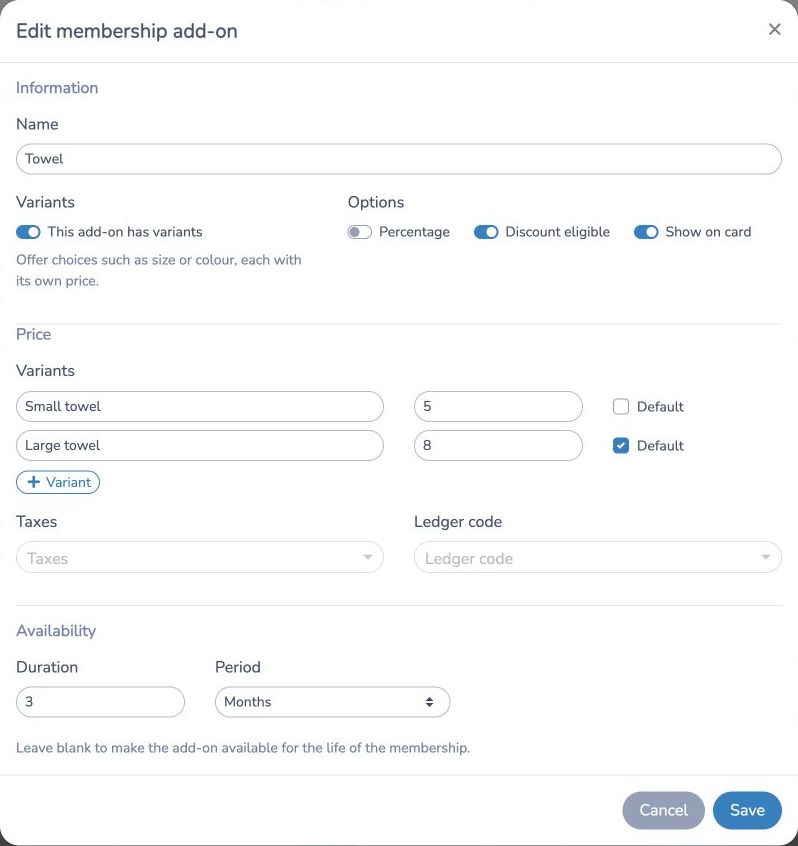
Use Add-ons for optional items or entitlements sold with a membership, such as a locker rental or towel service.
- Open the membership and select Add-ons.
- Select + Add-on, then enter its name.
- Turn on This add-on has variants when the client must choose one option, such as a small or large towel. Give each variant its own price and optionally select a default. Leave variants off to use one price for the add-on.
- Choose whether the price is a percentage, whether discounts apply, and whether the add-on appears on the membership card.
- Select the taxes and ledger code.
- Under Availability, enter a duration in days, months, or years. Leave the duration blank when the add-on should remain available for the life of the membership.
- Save the add-on, then save the membership.
The add-on period begins on the later of the member's activation date and the add-on purchase date. Activity Messenger calculates the expiration in the organization's timezone and stores the dates on the purchased invoice item. Changing the add-on definition affects future purchases only; it does not change an add-on already purchased.
Add-ons can be offered through a membership question on a payment form or added by an administrator from the membership invoice. Active add-ons appear in the Member window and the client account's Memberships tab. When Show on card is enabled, they also appear on membership cards and wallet passes.
An add-on remains in invoice history after it expires, but it disappears from active member views, cards, and filters. The same add-on can be purchased again after expiration. Renewing or replacing a membership does not automatically issue it again.
# Configure membership communications
Use Communication to choose the email templates associated with this Activity Messenger membership.
The personalized holder email is an optional setting for each membership and is off by default. Enable it only when every additional holder should be contacted directly. Leave it off when the account owner is expected to communicate with the other participants, such as a parent managing children's memberships, a company coordinating employee onboarding internally, a gift that should remain a surprise, or a preliminary/imported record that should not trigger a notification.
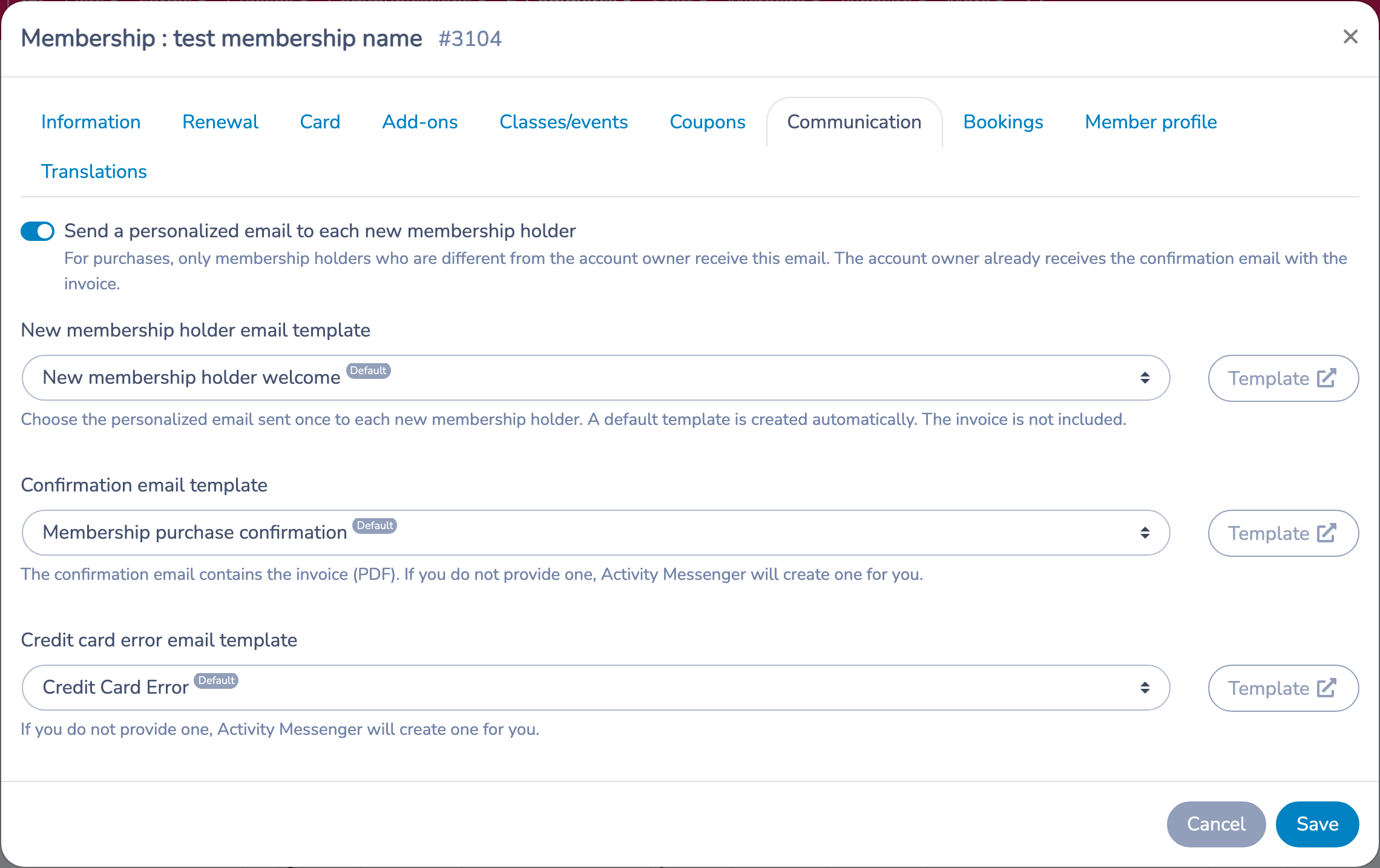
- Turn on Send a personalized email to each new membership holder to send onboarding instructions directly to each additional membership holder. Choose the New membership holder email template, or use the default template Activity Messenger creates automatically. You can open the selected template to add personalized merge fields, instructions, links, and next steps.
- For a purchase, the account owner receives the purchase-confirmation email with the PDF invoice. Each membership holder who is different from the account owner receives the personalized holder email once, without the invoice. This works when one invoice contains memberships for several different people; it is one message per additional holder, not one message per invoice.
- When an administrator manually creates a member from the membership list, Send the personalized email to this member is selected by default when this feature is enabled. Turn it off for a correction or administrative addition that should not notify the member. The template link beside the option shows which email will be sent.
- Confirmation email template is the message sent to confirm the purchase. Its PDF invoice is attached. When you create a membership without selecting a template, Activity Messenger creates a default membership-purchase confirmation template.
- Credit card error email template is the message used when an automated card payment fails. Activity Messenger can create a default credit-card-error template when none is selected while creating the membership.
- After selecting a template, use Template to open and edit it in a new browser tab.
The selected templates are stored on the membership. Changing a selection affects later messages; it does not alter messages already sent.

# Configure the member profile
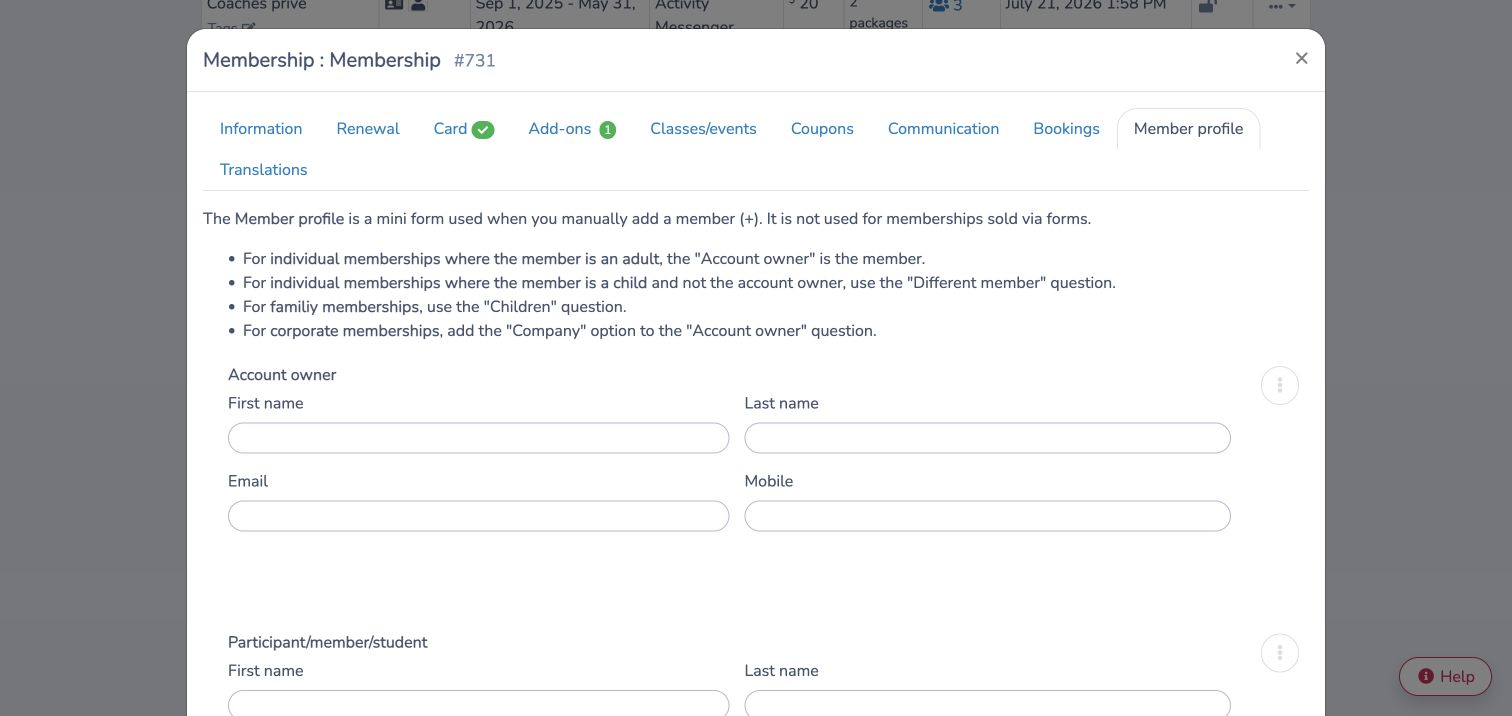
The Member profile is the mini form administrators complete when they manually add a member with + from the membership's member list. It is separate from a payment form: a membership sold through a form uses that payment form's questions instead.
Design the profile around who owns the account and who receives the membership:
- For an individual adult membership, Account owner can also be the member.
- For an individual child membership, add Different member so the account owner and member can be different people.
- For a family membership, use Children to collect the covered family members.
- For a corporate membership, enable the company field on Account owner.
Add, edit, reorder, or remove profile questions to collect the information administrators need when creating or updating a member. A new Activity Messenger membership starts with an Account owner question. Saving the membership creates or updates its dedicated profile form, and duplicating the membership copies those questions into a separate profile form.
When an administrator opens an existing member, Activity Messenger uses the same profile definition to display and update the member's saved answers.
# Configure translations
Use Translations to provide the client-facing membership content in the organization's other language.
# Sell or manually issue a membership
Memberships can be:
- Added to a payment or registration form and purchased on an invoice.
- Assigned manually from the membership's member list.
- Assigned through supported affiliation or external-membership workflows.
The issued member receives an activation date in the organization's timezone. A finite membership also receives an expiration date. A non-expiring member receives no expiration date.
# Manage members
Select the member count in the Memberships table to open the member list. You can search and filter by status or date, add a member, message filtered or selected members, print Letter or CR80 cards, and export to Excel.
Open an individual member to manage:
- Status, member number, notes, and photo.
- Activation and expiration dates.
- Assigned add-ons.
- Coupon balance.
An administrator may set or clear the expiration of an issued non-expiring member. The expiration cannot be cleared when the membership definition has a finite duration.
# Understand validity and access
A member is time-valid on or after activation and, when an expiration exists, through the expiration date inclusively. An empty expiration is an open-ended interval.
Time validity is only one check. Access, registration, and card status can still be affected by:
- Pending, suspended, cancelled, or archived status.
- The membership definition being archived.
- An unpaid balance or failed payment gate.
- A required current class or booking.
- The membership or coupon access schedule.
- Ignore at access control.
For access-control troubleshooting, review the scan result and E-Commerce → Reports → Access Control Logs. Coupon balances are recorded in the access log when applicable.
# Maintain the membership list safely
- Use Duplicate for a new season or variation, then verify dates, price, renewal/recurring settings, linked resources, coupons, and templates.
- Use the lock to prevent other administrators from editing, duplicating, or archiving the definition.
- Archive historical definitions instead of deleting financial history. Use the Archived filter to review or restore them.
- Pin frequent memberships, organize them with tags, and use the reorder tool to control their order.
- Before publishing a purchase form, test one purchase or manual assignment. Verify the invoice, member dates and status, coupon count, card/wallet preview, class or booking eligibility, and access-control behavior.