Activity Messenger Help Center
Send your first email or SMS
Start by sending a short message to yourself. Check the result in your inbox or on your phone, then prepare a separate message for your intended audience. This helps you confirm the channel, wording and reply settings before contacting clients.
Before you begin
You need permission to send messages in the organization. Check that your own account has the email address and mobile number needed for your test. An SMS test is a real send and can use your SMS balance.
For a client send, first identify the relevant list, class, form or client records. See Choose an audience if you are unsure where to start.
1. Open a new message
Open Communications > New message. You can also open All messages and use its new-message action.
Choose Email, SMS and email, or SMS. If your organization enables Client preferences, that option follows the client’s chosen channel, with email as the default when no preference is set. For a first test of a specific channel, select that channel explicitly.
Choose Marketing for a promotion or Non-marketing for an operational message. An internal test of a class-update message can use Non-marketing; a promotional campaign should remain Marketing when prepared for its real audience.
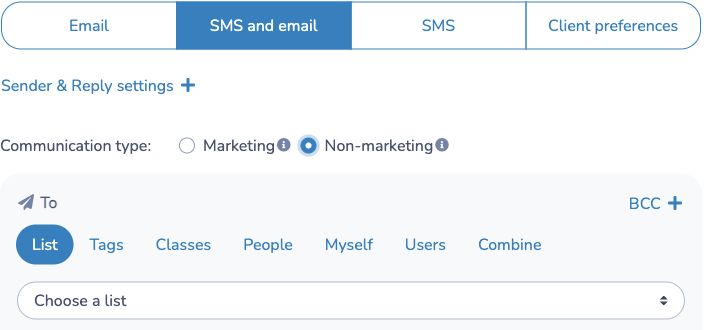
2. Choose Myself
In To, select Myself. Confirm that you have not selected a client list or added users in BCC.
This is a useful first delivery check, but it does not reproduce every client’s registration or participant context. A placeholder that depends on a class or form still needs to be checked in that context before a client send.
3. Write a short message
For email, enter a clear Email subject. Write the message in the editor. For example:
Reminder: Saturday’s swim lesson starts at 9 a.m. Please arrive ten minutes early.
Keep essential details in the SMS text. Longer SMS content can use several billable segments or be shortened with a link to the complete message, depending on the organization’s long-message setting. The displayed count is an estimate; see SMS, images and message length.
Use Use an HTML Template for a designed message. A template can appear in full in email, while the SMS includes text and a link to its hosted content. You can also use Quick messages or insert placeholders; review the selected content after doing so.
4. Preview and check reply settings
Use Preview to inspect the message. If you selected both channels, inspect the email and SMS versions. Open Sender & Reply settings to check where replies will go.
If you are not ready to send or schedule the message, click Save draft. Saving does not send or schedule it. To continue later, open Communications > All messages, choose Drafts from the filter, and select the draft to reopen it in New message. Other authorized admins can edit a draft; only its owner can delete it.
Before sending, confirm:
- The audience is still Myself, with no unintended BCC users.
- The subject, text and links are correct.
- Any placeholders have appropriate values for the selected context.
- The displayed counts and estimated cost are reasonable.
The preview is a check of the prepared message, not a guarantee that every email client or phone will display it identically. For an image or document sent by SMS, expect a link rather than an MMS attachment.
5. Send the test and inspect it
Click Send when you are ready for the real test message. Check your email inbox and/or phone for the selected channels. Open any links and confirm that the content is readable.
Use All messages to find the send and review its status. If it does not arrive, inspect delivery results before sending repeatedly. A resend is another send, and another SMS can use additional balance.
6. Prepare the client send
Create a separate message for the intended audience, or start from the relevant list, form or class. Recheck the audience, communication type, placeholders, reply settings and estimate before sending.
Do not assume a test to yourself proves that a registration-based audience or its placeholders are correct. Review the actual client context. Use Recipients and sending options for both-parent delivery, BCC and contextual entry points.
To send later, follow Scheduling messages. After sending, use Tracking messages to review results.
Settings reference
| Setting | Where | Default | Effect |
|---|---|---|---|
| Email / SMS and email / SMS / Client preferences | Communications › New message, first control | The Default type of message in Organization settings › Messaging (SMS and email unless changed). When Allow clients to choose their communication preferences is on, the default is Client preferences | Chooses the channel. Client preferences sends each client one message through their preferred channel, and email when they have not chosen one. |
| Communication type: Marketing / Non-marketing | New message, Communication type | The Default type of communication in Organization settings › Messaging (Marketing unless changed) | Marketing skips people who unsubscribed from marketing messages. Non-marketing still reaches them, but email addresses that bounced are skipped. |
| Sender & Reply settings | New message, link next to the channel choice | Collapsed | Shows From, Reply to and Suppress automatic email replies. |
| From | Under Sender & Reply settings | Your organization's From email address and SMS number | Email: choose among your verified From addresses. SMS: the sending number is shown and cannot be changed in the message. |
| Reply to | Under Sender & Reply settings | Email: the organization's Reply-to email (your own email if none). SMS: the organization's SMS reply preference | Email: where replies go. SMS: forward to the organization's reply-to mobile, forward to your confirmed mobile, SMS auto-reply or SMS no reply. |
| Suppress automatic email replies | Under Sender & Reply settings, email only | Off | Asks supported email providers not to send out-of-office or other automatic replies. Recipients can still reply normally. |
| To | New message | Depends on where you started (a list, a person, or Myself) | Chooses the audience: Myself, List, People, Classes, Users, Combine and other options enabled for your organization. |
| BCC | New message, BCC link next to To | None | Adds users who receive a copy. The panel is labelled Blind Carbon Copy. |
| Email subject | New message, email only | Message from (your organization name) | The subject line of the email. It is not used by SMS. |
| Use an HTML Template | New message, below the message | Off | Applies a saved template. Email carries the full design; SMS carries your text and a link to the web version. |
| Attachment | New message, below the message | None | One of: Attach a form (waiver), Link to a URL, a document or a page, Attach a video, Attach an image, Attach a certificate. Video, image and certificate are unavailable while a template is selected. |
| Save draft | New message, bottom buttons | Not saved | Keeps the message for later. It does not send or schedule it. |
| Preview | New message, bottom buttons | Not applicable | Shows the email and SMS versions before you send. |
| Schedule | New message, bottom buttons | Not applicable | Sends later instead of now. See Scheduling messages. |
| Send | New message, bottom buttons | Not applicable | Sends immediately. SMS can use your SMS balance. |
Common questions
Can I send an email and an SMS in the same message? Yes. Choose SMS and email at the top of the composer and write one message; the email uses the subject and the SMS carries the text. Review both in Preview. See 1. Open a new message.
Does a test to myself cost anything? An SMS test is a real send and can use your SMS balance, just like a send to a client. Choose a single channel if you only want to test one. See Before you begin.
Why was my SMS shortened or split into several messages? A standard SMS holds 160 characters per segment (fewer with emojis or special characters), and longer messages are billed as several segments but arrive as one message. Above 350 characters, Activity Messenger shortens the text and adds a link to the full message, unless your organization turned on Remove character limit on long SMS in its Messaging settings. See 3. Write a short message.
Can I send an image or a PDF by SMS? Not as an MMS attachment in a standard send. An image, video, certificate or link is added to the SMS as a link the recipient opens. Use Attachment to add it and check the link on your own phone. See SMS, images and message length.
What is the difference between Marketing and Non-marketing? Marketing is for promotions and excludes people who unsubscribed from marketing. Non-marketing is meant for service messages such as invoices, class reminders and account updates, and it also reaches people who unsubscribed from marketing. Do not use it for promotional content. See Recipients and sending options.
Where do replies go? Email replies go to the Reply to address under Sender & Reply settings. SMS replies follow the SMS reply choice, and they are not forwarded to your own phone unless your mobile number is added and confirmed in your account. See 4. Preview and check reply settings and SMS sender numbers and reply-to numbers.
Can I stop and finish the message later? Yes. Click Save draft, then open Communications › All messages, choose Drafts in the filter and select it. Other authorized admins can edit the draft; only its owner can delete it. See 4. Preview and check reply settings.