
Home
Account setting
Staff
Lists
Forms
Templates (HTML emails/SMS messages)
Sending messages by SMS and email
Classes, events, attendance and Zoom
Automation
Create a birthday invitation and automation
Communication
Microsite
E-Commerce
Networks, Federations and Franchises
How to guides
Personal information and electronic message laws in Canada and the USA
Get support
Terms and conditions
RL-24
https://activitymessenger.com/
10410 Waverly, Montréal, H3L 2W4
Terms and conditions

Bookings with memberships and players
Use memberships to control who can reserve a court, then identify the players and calculate their shares according to their membership. This companion to the Bookings guide uses the Tennis package at HogwartsRec to explain the Membership, Payment and Players tabs, followed by the client experience in the Microsite.
# Before you begin
Open E-Commerce → Booking packages, then open your package. You need administrator access to manage the package and its memberships. Configure the resource, booking duration, availability and schedule first; these are covered in the main Bookings guide.
Create the memberships under E-Commerce → Memberships and give them access to the package. For the example, the membership is named Membership Plus. Clients must use the account associated with their membership so the Microsite can recognize it.
If your booking form collects the other players through Person questions, include enough additional questions for the maximum player count. For four players, provide three additional Person questions and leave them optional in the form; the booking workflow makes the appropriate players required according to the count selected.
# 1. Membership: decide who can book
The Membership tab controls access to the reservation. The Players tab, described below, controls the price and conditions for the people taking part.
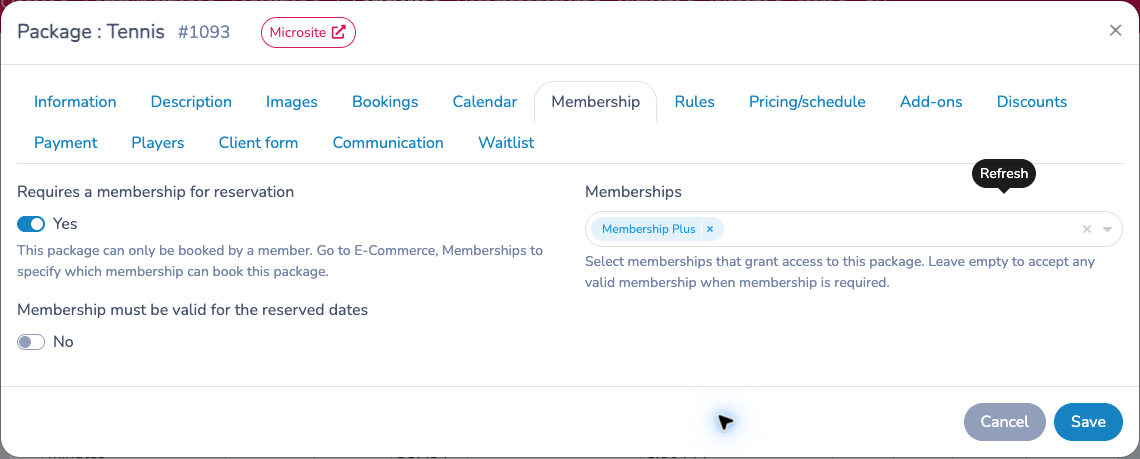
- Turn on Requires a membership for reservation to restrict booking to members.
- Select the memberships that grant access under Memberships. Tennis selects Membership Plus. When membership is required, leaving this list empty accepts any valid membership.
- Decide whether to enable Membership must be valid for the reserved dates. Enable it when the membership must cover the dates being booked. Tennis leaves this additional date requirement off.
- Save your package after configuring it.
Requiring a membership to make the reservation does not automatically make every invited player a member. You can allow a member to reserve and bring a non-member, then charge the guest according to the player rules. If every player must meet specific conditions, configure those rules and Player must meet constraints in the Players tab.
# 2. Payment: decide who pays and when
The Payment tab sets the payment methods and collection timing. Player pricing determines the amounts; deferred payment determines how those amounts are collected.
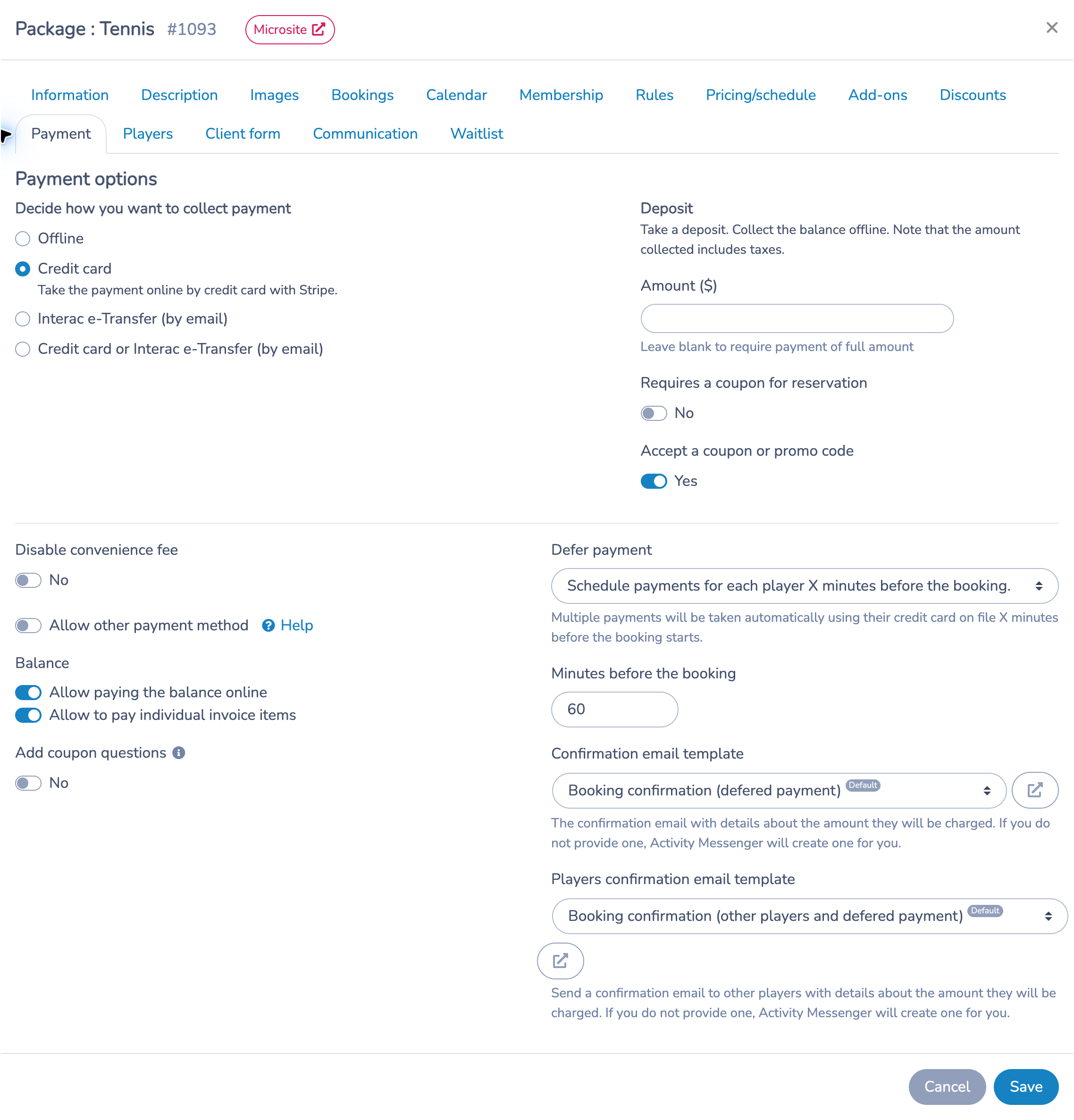
Tennis uses Credit card, leaves Deposit blank, and selects Schedule payments for each player X minutes before the booking under Defer payment, with Minutes before the booking set to 60. The checkout presents the scheduled charges for the client to review.
The deferred-payment choices let you schedule one payment or separate payments for the players, either at the end of the booking or using the before-booking option. Choose the per-player option when members should pay their own shares. This setup requires a membership-based booking package and a compatible online card payment configuration without a deposit.
For split deferred payments, the account making the booking must have a card on file. Checkout asks for one when it is missing. Review the payer and card status shown for each scheduled charge: a player entry and a separate payer are not always the same thing, particularly for people belonging to one family account.
The example also enables Allow paying of the balance online and Allow paying of individual invoice items. These let clients settle an outstanding balance or selected items online; they are separate from the choice to schedule charges for each player.
Confirmation emails and coupons
Use Confirmation email template for the person making the reservation and Players confirmation email template for the other players. These deferred-payment confirmations explain the amounts to be charged. Activity Messenger creates a default template if you do not select one.
Tennis accepts coupons or promo codes but does not require one. A membership grants booking eligibility; a coupon applies its own discount or coverage rules. Accepting coupons does not give every guest a free visit automatically.
# 3. Players: identify participants and calculate their prices
Choose the permitted number of players
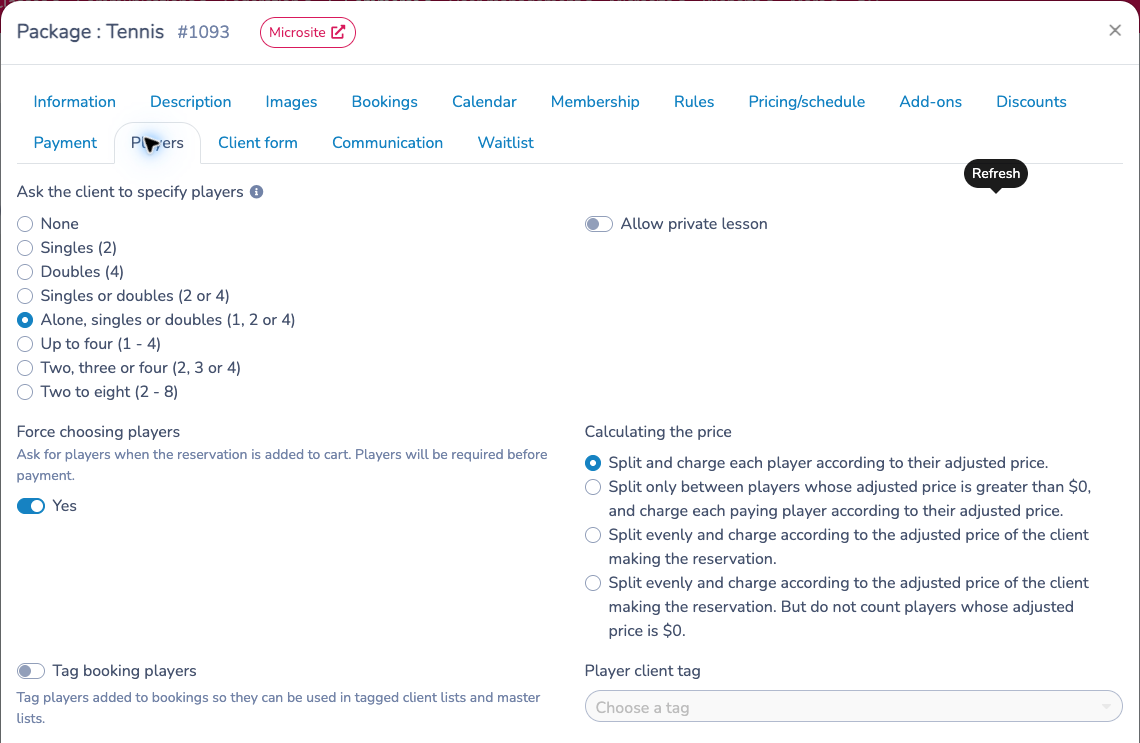
Under Ask the client to specify players, Tennis selects Alone, singles or doubles (1, 2 or 4). This allows a solo reservation, singles or doubles. It does not offer three players. Other choices support fixed singles or doubles, up to four players, and other listed ranges.
Turn on Force choosing players to collect the players when the reservation is added to the cart and require them before payment. Tennis has it enabled. Choosing a player count alone is not enough: the required people must also be identified.
Set member and guest prices
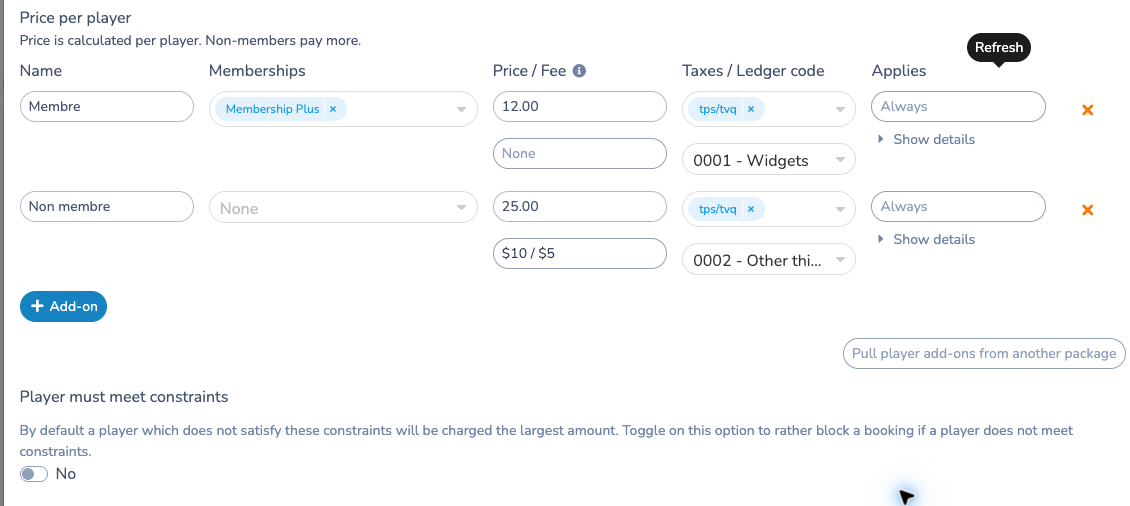
Under Price per player, add pricing rows using Add-on. For each row, set a name, the matching memberships, a price, any fee, taxes and ledger code. Applies and Show details let you review or refine when the row applies. You can also use Pull player add-ons from another package to reuse an existing setup.
The Tennis example contains these configured values:
| Player rule | Membership selection | Adjusted price | Additional fee |
|---|---|---|---|
| Member row, named “Membre” | Membership Plus | $12 | None |
| Non-member row, named “Non membre” | None | $25 | $10 standard or $5 junior |
These are the configured prices before the selected splitting rule is applied. They are not necessarily the final amount charged to each player. The general calendar price is also a starting price; the identified players, duration, fees, taxes and applicable discounts determine the cart total.
Understand the four price-splitting choices
Calculating the price offers four approaches:
- Each player's adjusted price, counting all players: divide each person's adjusted price by the player count. Tennis uses this option, so members and non-members can pay different shares.
- Each player's adjusted price, counting only paying players: exclude players whose adjusted price is $0 from the divisor. Their base share remains $0.
- The booking client's adjusted price, counting all players: use that client's adjusted price as the common basis and split it evenly.
- The booking client's adjusted price, excluding $0 players: use the booking client's price while excluding the eligible zero-price additional players from the split.
Additional fees have their own splitting setting. A $0 base share does not necessarily waive a fee.
For a one-hour singles example with one member and one adult non-member, using the displayed Tennis rules and no other adjustment:
- Member share: $12 ÷ 2 = $6.
- Non-member share: $25 ÷ 2 = $12.50, plus the unsplit $10 guest fee, for $22.50.
- Total before taxes and any payment fees: $28.50.
Do not divide the combined $12 and $25 equally between the two players. The selected option divides each person's own adjusted price. Changing the player count can therefore change the shares.
Configure guest and junior fees
Click the fee button beneath the price to open Fee. Tennis has a standard $10 non-member fee and a $5 junior fee for an age below 18. The junior rule depends on the player's age information; collect the relevant date of birth or age through the player question so the rule can be evaluated.
The fee options let you charge it as a separate invoice item, split it between players, apply it only once per day, and adjust it by booking duration. Tennis keeps the fee with the player add-on, does not split it, and adjusts it by duration. For the one-hour example above, the full adult fee is added after the base share is calculated.
Enforce conditions and organize players
Player must meet constraints is off in Tennis. With it off, a player who does not satisfy the configured conditions is charged the highest amount. Turn it on when the booking must instead be blocked if a player fails the conditions.
Tag booking players and Player client tag can tag the players for tagged client lists and master lists. Tennis leaves tagging off.
Changes after booking
The lower part of the Players tab explains when the invoice owner can add, remove or swap players from their client account. The invoice must be finalized, the booking must not be cancelled or ended, and the permitted player count must be respected.
On unpaid invoices, changing the roster recalculates the prices and scheduled payments. A replacement keeps the same player count. Changes are logged and a roster-change email goes to the owner, current players and the removed or replaced player.
Allow player changes after full payment is available only when payment is not deferred, so it is disabled in this Tennis setup. When enabled for an eligible package, paid roster changes preserve the invoice amount and add new players at $0; they do not reprice a paid booking.
# 4. Microsite: what the client sees
Choose a time and a member
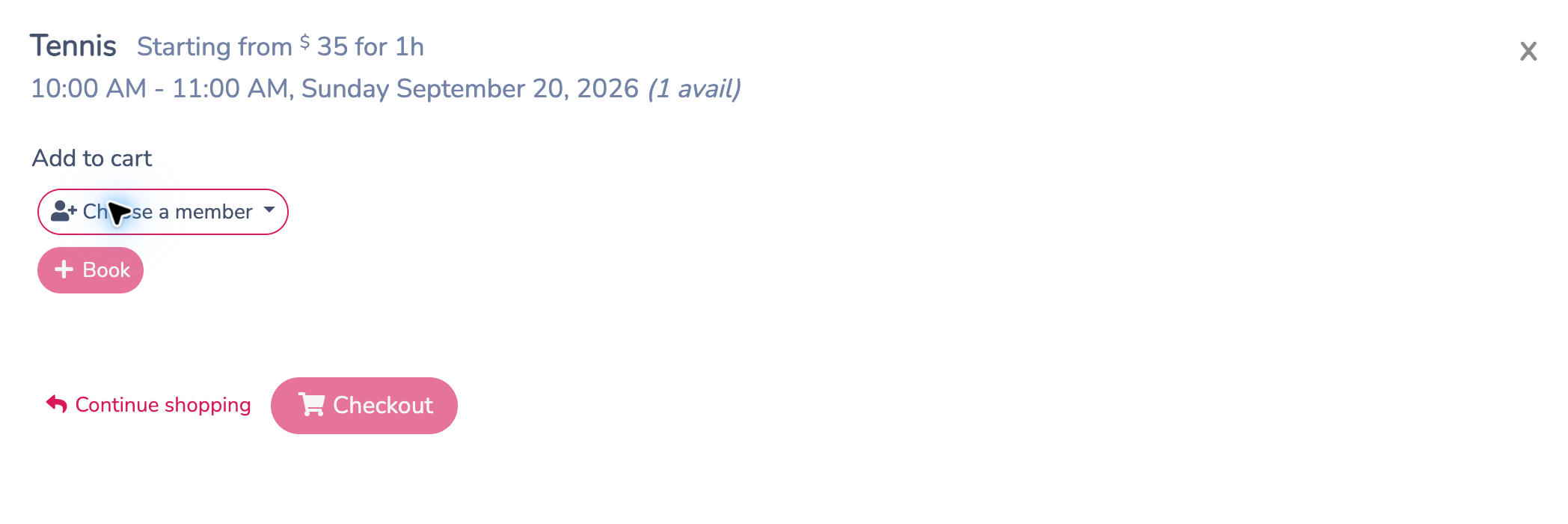
Open the package in the Microsite. The calendar shows available times, duration choices and starting prices. Select a time and review its date, start and end time before booking.
For a membership-required package, use Choose a member to select the eligible person in the signed-in account. The member selection establishes who is booking. If a person is marked No valid membership, the client cannot use that person to book this package. Check the account, accepted membership and validity requirements before trying again.
Choose the players in the cart
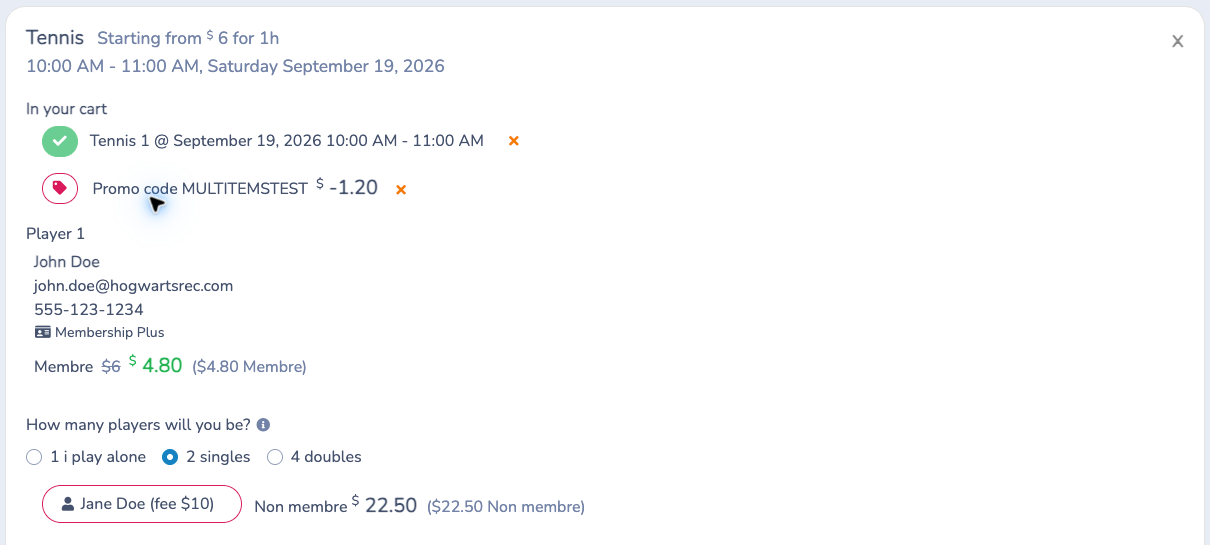
After adding an eligible reservation, review Player 1, choose the permitted format or player count, then use Choose a player for each additional player. Select an existing person or complete the player information requested by the form. Use the correct account identity and email so memberships and any eligible coupons can be recognized.
The reservation displays the players and their applicable prices. Review each person rather than assuming every player receives the booking member's rate. With forced player selection, missing required players must be completed before checkout.
Review the live cart
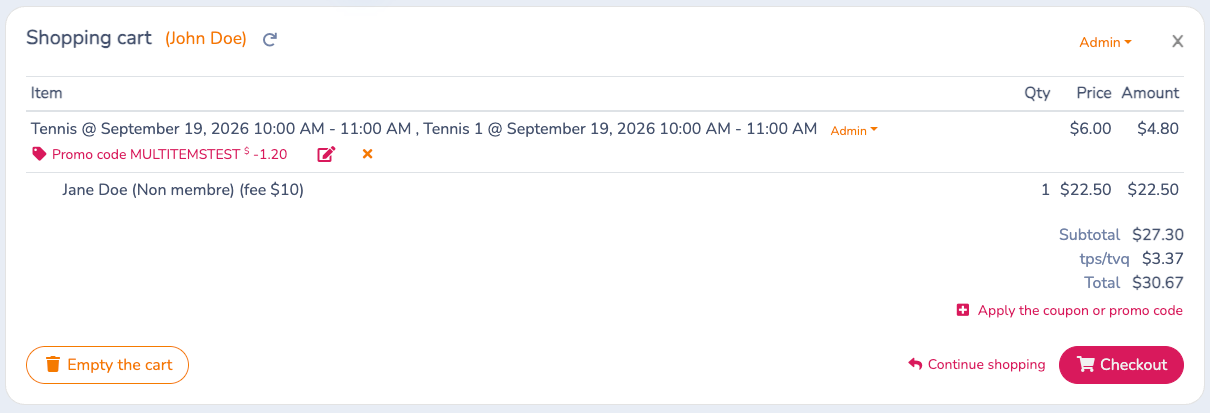
This live example has John Doe as the member and Jane Doe as the non-member for a one-hour singles booking. The MULTITEMSTEST promo code reduces John’s $6 share by $1.20 to $4.80. Jane’s $22.50 includes her $12.50 base share and $10 guest fee. The cart shows a $27.30 subtotal, $3.37 in taxes, and $30.67 total. These are example-specific discounts and taxes; your own rules determine the result.
Use the pencil beside the reservation to review the players again, or Checkout to continue through Your information to Payment. The screenshots were taken in an administrator preview of the live cart, so ordinary Admin controls also appear.
Review the payment breakdown
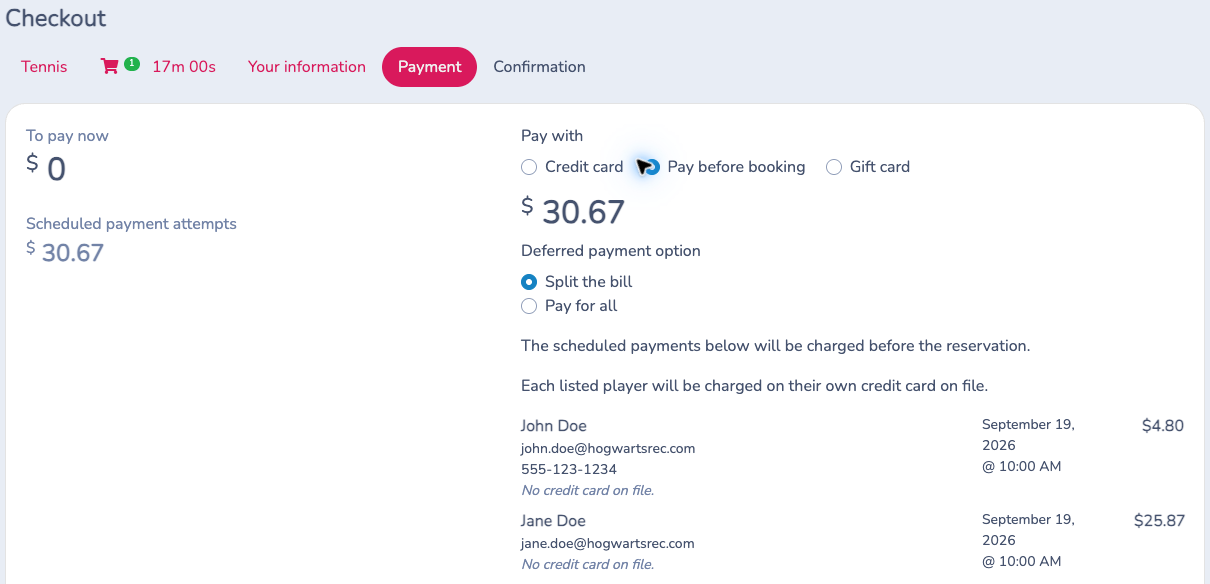
At checkout, review the booking, players, fees, taxes and total. For a split deferred-payment package, Deferred payment option offers Split the bill or Pay for all when applicable:
- Split the bill shows the scheduled charges assigned to the respective payers.
- Pay for all assigns the full deferred amount to the account making the reservation.
In the live Payment page, Pay before booking and Split the bill are selected. To pay now is $0, while Scheduled payment attempts total $30.67: $4.80 for John and $25.87 for Jane, including the tax assigned to her share. Splitting the bill preserves these different amounts; it does not divide the total in half.
Both rows show No credit card on file. The page therefore asks the booking account to add a card before it can reserve. This screenshot shows the review step, before a card is saved or the reservation is confirmed. The displayed schedule is September 19, 2026 at 10:00 AM for both payers. Use the actual date and time shown at checkout when reviewing collection timing.
For each scheduled charge, inspect the payer, amount, date and time, and card-on-file status. Follow the prompt to add a required card if one is missing. A scheduled charge is a future collection, not a completed payment. Review the displayed schedule before confirming.
# Troubleshooting
A member cannot book: verify the signed-in account and selected person, the membership's access to the package, its validity and the package's date-validity option.
The price differs from the calendar: check the identified players, matched pricing rows, splitting choice, duration, guest or junior fees, taxes and coupons. The calendar's starting price is not a promise of the final per-player amount.
Checkout still asks for players: verify both the selected count and every required player entry. A missing or incomplete person can keep checkout blocked.
A scheduled payment shows no usable card: the relevant payer needs to add or update their card. Review the payment schedule again; membership eligibility alone does not supply a payment method.
A client cannot edit players after payment: check whether the invoice is already paid, whether payment is deferred, and whether the booking has ended or been cancelled. The paid-change option is not available with deferred payments.
For resources, availability, schedules and administrator bookings, see Bookings. For membership setup, see Memberships.