If you’ve ever left a kids’ birthday party thinking “I could do this better,” you might be onto something. Parents spend real money to make their kids’ birthdays feel special, and plenty of them would rather pay a professional than spend a weekend gluing streamers to a living room wall.
Knowing how to start a birthday party business means understanding who you’re serving, what you’ll charge, what you’re legally on the hook for, and how you’ll actually get your first few bookings.
This guide walks through each of those steps, whether you’re building a standalone party-planning business from scratch or already run an activity centre and want to turn parties into a real revenue stream.
Key Takeaways:
- Pick a niche and age group to target before you build packages. Trying to serve everyone usually means you serve no one well.
- Budget realistically: most new party businesses spend thousands to get started, and monthly costs need to be built into your pricing.
- Legal setup (business registration, licensing, insurance, waivers) isn’t optional, even for a side hustle.
- Package your services into two or three clear tiers so parents can choose quickly rather than get overwhelmed.
- Marketing works best as a mix of a mobile-friendly booking page, local SEO, social proof, and referrals, not any one channel alone.
- If you’re already running a dance studio, gym, or activity centre, you may not need to build a party business from the ground up. You can formalize what you’re already doing.
Table of Contents
- Is Starting a Birthday Party Business Worth It?
- What the Birthday Party Business Market Looks Like Right Now
- Two Paths: Starting New or Adding Parties to What You Run
- Pick Your Niche
- Price and Budget With Intention
- Cover Your Legal Bases
- Systems You’ll Need Before Booking Your First Party
- Bonus: See How Nex Level Ninja Added $15k+ in Monthly Revenue with Birthday Parties
- Build Packages a Parent Can Book in Five Minutes
- Line Up Vendors and Supplies
- Get Found, Get Booked
- Run the Party, Then Follow Up
- Common Mistakes New Birthday Party Businesses Make
- Frequently Asked Questions
- Conclusion
Is Starting a Birthday Party Business Worth It?
For a lot of people, starting a birthday party business can be very rewarding. Parents are busier than ever, and many are willing to pay someone else to handle the decorations, activities, entertainment, and cleanup.
Birthday parties also fit different goals depending on where you’re starting from:
- 🕒 Side hustle: many planners start by booking one or two parties a weekend alongside a full-time job
- 📈 Full-time business: with consistent bookings, repeat customers, and referrals, parties can become a steady primary income
- 🏋️ Already running an activity business: dance studios, gymnastics clubs, swim schools, martial arts schools, and rec centres often have a head start, since they already have the space, instructors, and equipment families are looking for
Which of these you’re aiming for changes a lot of what follows, including how much you invest upfront and how fast you need to reach profitability.
What the Birthday Party Business Market Looks Like Right Now
Parents care about their kid having a great party, and a lot of them are stretched thin when it comes to planning one. A 2024 survey by the What to Expect Community found parents spend an average of $314 on a child’s birthday party, with that number climbing to $344 for six- to ten-year-olds, the age range where expectations tend to be more specific.
That national picture is a starting point, not a substitute for checking your own area. Before committing to a niche or a package structure, it’s worth a bit of local reconnaissance:
- 🔍 How many party businesses or venues already serve your area?
- 💵 What are they charging?
- 👶 Which age groups do they focus on?
- 🕳️ Is there a gap nobody’s filling, like sensory-friendly parties, STEM activities, or mobile entertainment?
If you’re already running an activity business, you have a shortcut here. Your own registration data already tells you the age range and volume of families you serve, which is a more reliable signal than sizing up the market from scratch.

Two Paths: Starting New or Adding Parties to What You Run
Before picking a niche or setting prices, it helps to know which situation you’re actually in.
Starting from scratch. You’re building a party business as its own venture: sourcing vendors, defining a niche, and building a client list with nothing to draw on yet. It takes longer to reach steady bookings, but you get full control over how you position and price everything.
Adding parties to a business you already run. If you run a dance studio, gymnastics club, swim school, or similar program, you already have the space, the staff, and often quiet weekend hours. Learning how to start a birthday party business in this context looks less like launching something new and more like turning an existing asset into a second stream of revenue.
The second path usually sees profits faster, since space, staff, and trust with local families are already in place.
What still needs building is the process: how a parent books a party, pays a deposit, gets a waiver signed by guests, and hears from you again after the party is over.
Whether you’re starting from scratch or adding birthday parties to an existing business, having a consistent process for bookings, payments, waivers, and communication makes it much easier to stay organized as your calendar fills up.
Pick Your Niche
Trying to appeal to every family usually makes it harder for parents to understand what makes your birthday party business different. Instead, choose a niche that matches your experience, equipment, and local demand.
Ask yourself a few questions before deciding:
- What age group do you enjoy working with most?
- Do you already have equipment or a venue you can use?
- Will you travel to customers or host parties in one location?
- Can you comfortably run more than one party in a weekend?
- What type of experience would parents have trouble finding elsewhere?
Once you’ve narrowed your focus, choose the type of service you want to offer:
- Full-service planning from invitations through cleanup
- Hosted parties at your own venue
- Mobile parties at the customer’s home
- Entertainment only
- DIY party kits with decorations and activities
What Parents Expect at Each Age
Package design gets a lot easier once you stop thinking of “kids’ parties” as one category and start thinking in age groups. What excites a three-year-old bores a ten-year-old, and what a tween wants looks nothing like a toddler party.
- Toddlers (1 to 3): Short attention spans rule everything. Soft play areas, sensory stations, and simple, familiar characters work better than elaborate themes they won’t remember.
- Young kids (4 to 8): This is peak theme territory. Pirates, princesses, dinosaurs, superheroes. Interactive activities matter more than decor at this age.
- Tweens (9 to 12): Think DIY stations, slime bars, gaming setups, or spa-style pampering. They want to feel a bit grown-up and entertained.
- Teens: Less about games, more about atmosphere. Music, photo-worthy setups, and food they’d choose for themselves.
If you already run an activity business, you likely have this age breakdown built in. A gymnastics studio’s typical age range naturally points toward tumbling-and-play toddler and young-kid parties, while a dance studio’s older students might be a better fit for a tween dance party format.
Price and Budget With Intention
Pricing is where a lot of new operators guess instead of calculate, and it shows up later as burnout or a business that never quite turns a profit.
Start with what a party actually costs you:
- Supplies and materials
- Your time (planning, shopping, setup, and teardown, not just the party itself)
- Any contracted help, like an entertainer or extra staff
If a mid-tier party costs $120 in supplies and takes eight hours of your time, and you price it at $450, your margin is around $330 before you account for what your time is worth.
Your own costs and market will differ, but running the math for your packages, rather than pricing off a gut feeling, tells you how many bookings you actually need per month to make this worthwhile.
If you’re adding parties inside an activity business, the math looks different. Your core costs, like rent, insurance, and staff, are usually already covered by your regular programs. The real question is whether the revenue from a party clears the added cost of staff time and supplies for that one event.
Cover Your Legal Bases
This part isn’t the fun part, but skipping it is how a good weekend turns into a legal headache. At minimum:
- ✅ Register your business. A sole proprietorship is the simplest setup. An LLC or incorporation gives you liability separation.
- ✅ Check local licensing. Requirements vary by city and province or state.
- ✅ Carry general liability insurance. This protects you if a child is injured or property is damaged.
- ✅ Add commercial auto coverage if you’re transporting equipment.
- ✅ Use signed waivers for anything higher-risk: bounce houses, animals, off-site activities.
- ✅ Put terms in writing for every booking, even small ones: what’s included, the date and location, payment and cancellation terms, and who’s responsible for supervising kids.
If you’re running parties inside an activity business that already has waivers and contracts for its regular programs, extend the same standards to parties instead of treating them as a smaller, casual version of your usual process.
Systems You'll Need Before Booking Your First Party
A great party starts long before guests arrive. Having a clear booking process saves time, reduces mistakes, and creates a better experience for parents.
A typical workflow looks something like this:
1. 🖥️ A parent books a party online
2. 💳 A deposit is collected automatically
3. 📧 A confirmation email outlines what’s included
4. 🎟️ Invitations or waivers are sent, if needed
5. ⏰ Reminder emails go out before the event
6. 💰 The remaining balance is collected
7. 🙏 A thank-you email and review request are sent after the party
Instead of juggling spreadsheets, email threads, payment apps, and paper waivers, many birthday party businesses use an online registration platform that keeps bookings, payments, waivers, reminders, and customer communication together.
A few pieces are worth understanding in more depth, since they’re where most of the manual work usually hides:
- Booking forms with calendar rules. Rather than a generic contact form, a proper party booking page lets you set fixed time slots (Saturdays at 1pm and 3pm, for example), cap how many parties run at once, and set booking windows so you’re not fielding requests for tomorrow or three years out.
- Deposits and automated balance collection. A deposit locks in the date at checkout, and the remaining balance can be charged automatically a set number of days before the party rather than something staff have to remember to invoice. If a card fails, an alert lets staff follow up quickly instead of finding out the day of the event.
- Branded, personalized invitations. Once a booking is confirmed, the parent gets an invitation pre-filled with the child’s name, date, time, and location, ready to forward to their guest list without any design work on their end.
- RSVP tracking tied to waivers. Guests confirm attendance and sign a digital waiver in the same step. Only guests who’ve completed both show up on the attendance list, so there’s no separate spreadsheet to reconcile.
- Day-of check-in. Staff work from a live digital list as guests arrive. For walk-up guests without an RSVP, a QR code handles waiver signing and check-in on the spot.
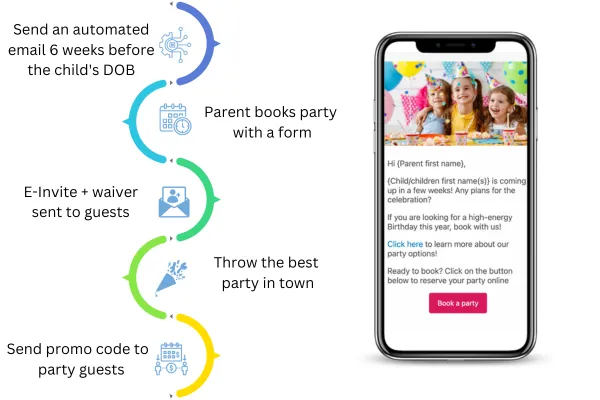
- Post-party follow-up and birthday-based campaigns. Automated thank-you emails go out after the party, often with a discount toward classes or camps. And because birthdate is already sitting in most registration systems, a segmented email can go out 6 to 8 weeks before a child’s next birthday, which is usually the highest-converting party marketing available to a business that already has families registered.
Activity Messenger lets you manage bookings, payments, waivers, reminders, and customer communication from one place. If you already use it for classes, camps, or events, birthday parties can fit into the same workflow.
For a birthday party business, switching to Activity Messenger can help you save valuable time and money, leaving more room for other administrative tasks and fun projects like brainstorming new offerings.
Check out some key insights on running a birthday party business from Olivier below 👇
🎉 Want to see how Activity Messenger can help you boost birthday party bookings and streamline every part of the process? We’ve published articles on the best birthday party software, marketing ideas, and how to create waivers for party events.
Bonus: See How Nex Level Ninja Added $15k+ in Monthly Revenue with Birthday Parties
“We started with Activity Messenger just for birthday parties, just to see how it would work. And now it’s our only CRM system. It’s been life-changing. The customer service is second to none; I would recommend them to any facility that does any type of birthday parties or class management.” – Kelly Denti, Owner of Nex Level Ninja
Build Packages a Parent Can Book in Five Minutes
Most parents are comparing options late at night or in a school pickup line. If pricing and packages aren’t clear within a minute of landing on your page, the booking often goes to whoever made the decision easier.
A simple structure helps:
- Basic package: decor, tableware, one activity
- Mid-tier package: decor, an activity or entertainer, favours
- Premium package: full setup and teardown, entertainment, food coordination
Booking mechanics matter just as much as the packages themselves:
- Availability visible upfront, not something a parent has to ask about
- A deposit collectible online
- The balance charged automatically as the date gets closer, rather than chased down by text
- A confirmation that doesn’t require more than one email exchange to lock in a date
Activity businesses running class registrations often find it easier to handle party bookings through the same system they already use, so staff aren’t managing a separate spreadsheet, a different payment process, and a second waiver system just for one event type.
Line Up Vendors and Supplies
Even a solo operation depends on a small network of people you can count on:
- Bakeries or bakers for cake
- Entertainers (face painters, magicians, characters)
- Rental companies for tables, chairs, and bounce houses
- A photographer for higher-end packages
Build relationships with two or three reliable options in each category so a single no-show doesn’t put a booking at risk. Also, be sure to vet anyone before you promise them to a client. Watch them work an event if you can, and ask how they handle the unexpected, because something always comes up.
Over time, you can build your own supply of reusable decor, storage bins, and setup gear, which reduces both cost and last-minute scrambling.
Get Found, Get Booked
Visibility matters more than the volume of effort you put in. A few channels tend to do most of the work:
- 📱 A booking page that works well on a phone. Most parents are browsing on mobile, often outside business hours.
- 🔍 Local search. Parents search with a location in mind, something like “kids party venue near me” or “[city] birthday party planner.” A claimed Google Business Profile and location-specific content do more here than most paid ads.
- 📸 Real photos and short video. A short clip from an actual party tends to outperform a styled photo. Get permission from families first.
- 🤝 Referrals. A recommendation from another parent carries more weight than an ad. A small discount or credit for referring a friend, mentioned while the last party is still fresh, tends to pay for itself.
Running parties out of an existing activity business gives you a channel most standalone operators don’t have: the families already registered with you.
An email sent six to eight weeks before a child’s birthday, to a list of parents who already know and trust your business, is often the highest-converting party marketing available.
If you’re already collecting customer information through your registration system, birthday reminder emails and promotional campaigns are much easier to automate. A reminder sent a few weeks before a child’s birthday can generate repeat bookings without requiring manual follow-up.
Run the Party, Then Follow Up
The event itself is where your reputation gets built:
- Confirm details and guest count about a week out
- Arrive early enough to set up without rushing
- Keep a small backup kit on hand for spilled juice, a deflated balloon, or whatever else comes up
A single great party earns you one happy family. What turns that into repeat business is the follow-up:
- A short thank-you message timed while the day is still fresh, and a natural moment to ask for a review
- A light follow-up to guest families, too, since they just watched you run a good event for their kid
- A reminder timed to that same family’s next birthday, so you stay top of mind without relying on memory
It’s the step most new operators skip because it takes some setup, and it’s usually the difference between a business that keeps finding new customers every month and one that grows from its own client base.
Automating thank-you emails, review requests, and birthday reminders helps you stay in touch with past customers without creating more administrative work.
Common Mistakes New Birthday Party Businesses Make
Many new businesses run into the same challenges during their first year.
Some of the most common birthday party business mistakes include:
- ❌ Charging too little without calculating labour and supply costs.
- ❌ Offering too many themes before knowing what customers actually want.
- ❌ Buying large amounts of inventory before demand is established.
- ❌ Accepting bookings without deposits.
- ❌ Operating without clear cancellation policies.
- ❌ Relying on Facebook Messenger or text messages to manage bookings.
- ❌ Forgetting to ask for reviews after successful events.
Avoiding these hiccups early can save time, money, and plenty of frustration.
Frequently Asked Questions
How much does it cost to start a birthday party business?
Costs to start a birthday party business vary by scale, but most new operators spend a few thousand dollars on supplies, a website, insurance, and basic booking tools before their first paid event.
Do I need a separate business if I already run an activity centre?
Not always. Many activity businesses run parties as a service under their existing registration and insurance rather than setting up a new legal entity. It’s worth checking with a local advisor or accountant to confirm what applies in your area.
What should I charge for a party package?
There’s no universal number. The easiest approach to determining your fees is to work out your own supply costs and time per party, then price so the margin actually reflects your effort, rather than copying a competitor’s price list.
Is it better to start small?
Most people learning how to start a birthday party business do better starting with two or three simple packages and expanding based on what actually books, rather than launching with a long menu of options nobody has tested yet. If you already run a business built for birthday parties, such as a gymnastics or martial arts studio, you might be able to scale faster.
Conclusion
Starting a birthday party business takes more than choosing decorations and setting a price. You’ll need a clear niche, realistic pricing, reliable vendors, a consistent booking process, and a marketing plan that keeps new customers coming in throughout the year.
If you’re running parties inside a dance studio, gym, swim school, or similar business, Activity Messenger helps you manage bookings, payments, waivers, and follow-up from one place, so birthday parties fit into the same workflow as your regular programs.
📅 Book a free demo to see how it works.