
Growing a swim school takes more than a great program and a clean pool. You need families to find you, trust you, and sign up before a competitor does. Whether you’re trying to fill spots mid-session, build a waitlist for next season, or just get your name in front of more local families, these swim school marketing ideas will give you a practical place to start.
Some of these strategies take an afternoon to put in place, while others are slow burns that build your visibility and reputation over time. If you implement even a handful of these consistently, you’ll spend less time scrambling to fill spots and more time focused on delivering great lessons to your students year after year.
Key Takeaways:
- Segment your email list into past, current, and potential clients. This alone can lower unsubscribe rates and raise open rates and registrations.
- Start taking registrations earlier than your competitors and use early-bird discounts to lock in 25-30% of enrolment before most schools have even opened their doors.
- A small daily Facebook or Instagram ad budget, often just $7-$10 per sign-up, can consistently fill empty spots in your classes.
- SMS messages have a 98% open rate and are typically read within minutes, making them your fastest channel for reminders, cancellations, and promotions. Always get proper opt-in consent first.
- Encourage every satisfied parent to leave a Google, Facebook, or Yelp review. Most will say yes if you ask promptly and make it easy.
- A frictionless, mobile-friendly registration form that handles payments, waivers, and confirmations in one flow can be the difference between a sign-up and a lost lead.
Table of Contents
- 1. Email Marketing
- 2. Early Bird Discounts
- 3. Social Media Marketing
- 4. Testimonials & Online Reviews
- 5. SMS Marketing for Swim Lessons
- 6. Improve the Online Registration Process
- 7. AI (ChatGPT) for Marketing
- 8. Swim Lesson Surveys
- 9. Client Referrals
- 10. Post-Session Guest Conversion
- 11. SEO for Swim Schools
- 12. Pay Per Click (PPC) Ads
- Where to Start
- Streamline Your Swim School With Activity Messenger
About the author: I’m Olivier, co-founder of Activity Messenger, a modern swim school management software. In addition to my role here, I ran a multi-location business focused on non-competitive sports for young athletes aged 2-9. Over the past decade, I’ve invested more than $200,000 in digital advertising through platforms like Facebook and Google, and sent countless email marketing initiatives. My hands-on experience is rooted in actively researching a range of marketing strategies specifically designed to increase enrolment.
1. Email Marketing for Swim Schools

At Activity Messenger, we see many swim schools using email campaigns to encourage former or returning students to sign up for the next session. That’s a great start. However, many of these campaigns only target past participants.
More critically, many swim schools don’t use email lists and opt-ins to let potential customers subscribe to their newsletters.
In our operations, when we introduced a newsletter signup option, we were amazed by the number of potential customers who left their email to stay in touch.
Segment by Past, Current vs Potential Clients
When it comes to digital marketing, it can be annoying to get an email promoting the swim class you’ve just signed up for, especially when it happens right after you sign up. That’s exactly what we experienced.
- ✅ The unsubscribe rate went down significantly
- ✅ The open rate went up
- ✅ The registrations went up
Now, families receive emails that are relevant to how they’ve engaged with us.
Ways to Enhance Your Swim School’s Subscriber List:
- On your website, include an opt-in feature.
- Make it easy to sign up for the newsletter by displaying a QR code at events.
- Encourage people to sign up during swim meets, open houses, or at the end of swim programs.
Welcome New Subscribers:
Engage new subscribers by sending a welcome email that gives them a taste of what to expect:
- Blog posts showcasing your expertise
- New subscriber promotions
- Previews of upcoming programs and sessions
With this approach, you can turn a simple thank-you into the start of a meaningful relationship with prospective swim school families.
📌 Pro Tip: Many parents discover our site through paid advertising or search. Oftentimes, their children are too young, or the family isn’t available for the current season. These parents are interested but can’t sign up yet, so keeping in touch with them can turn them into future customers.
2. Early Bird Discounts
One of the most effective strategies we’ve used to grow enrolment is surprisingly simple: open registration earlier than anyone else.
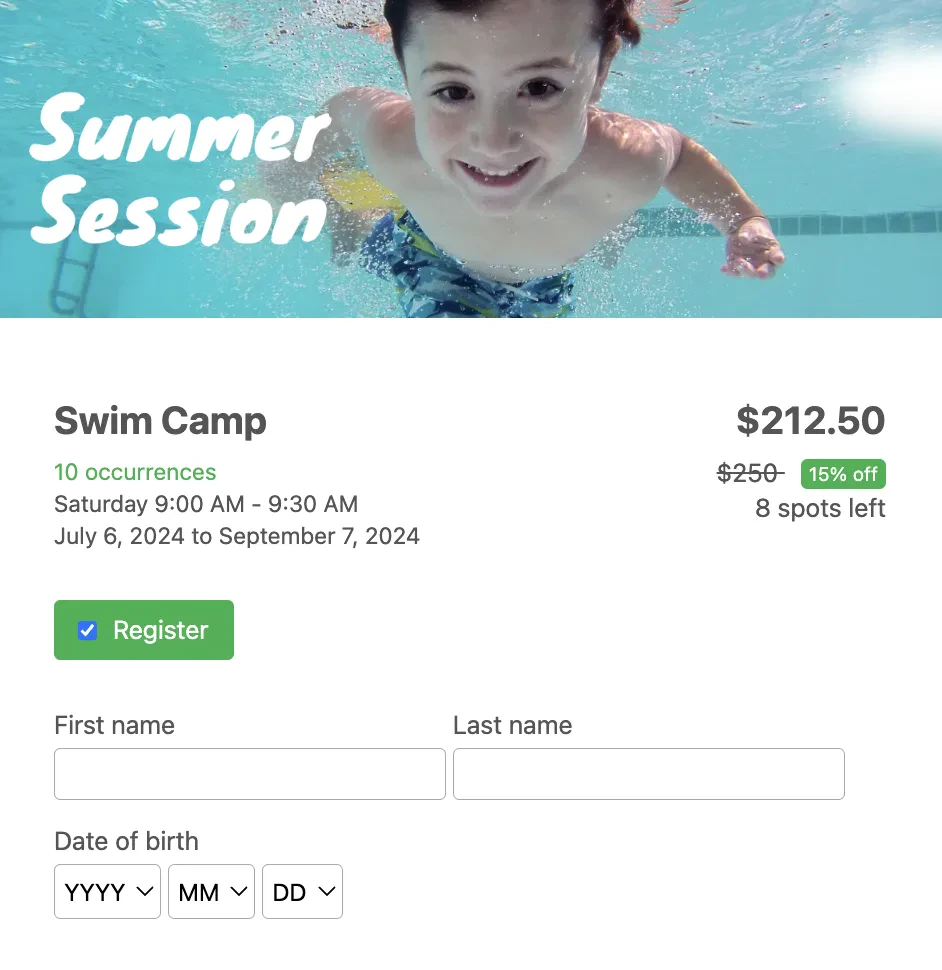
We start taking registrations well ahead of our competitors and pair that with early-bird discounts to reward families who plan ahead. This does more than just fill spots early. It improves cash flow, simplifies staffing decisions, and gives us a clearer picture of where we need to focus our marketing before a session begins.
If a particular program is selling quickly, we know to leave it alone. If another has plenty of open spots, we can shift our ad spend and email campaigns toward it before it becomes a problem.
How to make early-bird pricing work:
- Open registration earlier than you think you need to, ideally before your competitors have announced their sessions at all.
- Offer a clear, time-limited discount of around 10-15% for families who register by a specific date.
- Use the early registration data to guide your advertising spend rather than guessing which programs need more visibility.
- Promote the deadline across email, SMS, and social, so families feel the urgency without being pestered.
📌 Pro Tip: We’ve used this approach for years, typically reaching 25-30% enrolment before most competitors have even opened their doors. Knowing which programs still have openings lets me target my marketing exactly where it’s needed instead of running broad campaigns and hoping for the best.
4. Testimonials & Online Reviews
Most parents research a swim school before they ever contact you. They check Google, scroll through Facebook, and look for reviews from other families. If you don’t have a visible, positive presence on those platforms, you’re losing families to competitors before the conversation even starts.
The good news is that most parents are happy to leave a review after a great experience. They just need to be asked, and they need it to be easy.
How to get more reviews consistently:
- Ask directly and promptly. Send a follow-up email 2-3 days after a session ends with a direct link to your preferred review platform. Timing matters. Parents are far more likely to leave a review when the experience is still fresh.
- Make it personal. A message that references their child by name and thanks them for a specific session converts far better than a generic review request blast.
- Respond to every review, positive or negative. Responding to praise shows appreciation. Responding to criticism shows accountability. Both matter to families reading your reviews for the first time.
- Follow up with survey respondents. If a parent gave you a glowing rating in an end-of-session survey, reach out personally and ask if they’d be willing to share it publicly. Most say yes when you make it simple.
A few ways to make the most of what you collect:
- Feature standout testimonials prominently on your website, especially near your registration call-to-action.
- Use short quotes in social media posts, especially at the start of a new session, to drive sign-ups.
- Include a recent testimonial in your welcome email to new newsletter subscribers to build trust early.
📌 Pro Tip: Include a direct link to your preferred review platform in every post-session follow-up communication. The fewer steps between a happy parent and a published review, the more reviews you’ll get.
5. SMS Marketing for Swim Schools
SMS marketing is one of the most underused tools in a swim school’s arsenal, and one of the most effective when used at the right moment.
Unlike email, which might sit unread for days, text messages are typically opened within minutes, with a 98% open rate. That makes SMS the right channel for time-sensitive communication, not general newsletters.
When SMS works best for swim schools:
- Class reminders: Send an automated reminder 24-48 hours before a lesson. Fewer no-shows and fewer “I forgot” calls.
- Cancellations and rescheduling: When a class is cancelled due to pool maintenance or weather, a text reaches parents immediately, far faster than email.
- Session opening announcements: When a new session opens for registration, an SMS to your existing community creates an early surge of sign-ups before you spend a dollar on ads.
- Waitlist notifications: Alert families the moment a spot opens up. An automated text here converts far better than an email that gets buried.
- Promotional offers: Running a last-minute discount to fill a half-empty session? SMS is your best bet for a quick response.
📝 A note on compliance: Before sending any marketing texts, make sure you have explicit opt-in consent from each recipient. In Canada this is governed by CASL (Canada’s Anti-Spam Legislation), and in the US by the TCPA (Telephone Consumer Protection Act). Both require clear consent and an easy opt-out mechanism. A simple checkbox on your registration form covers you and builds trust with families.
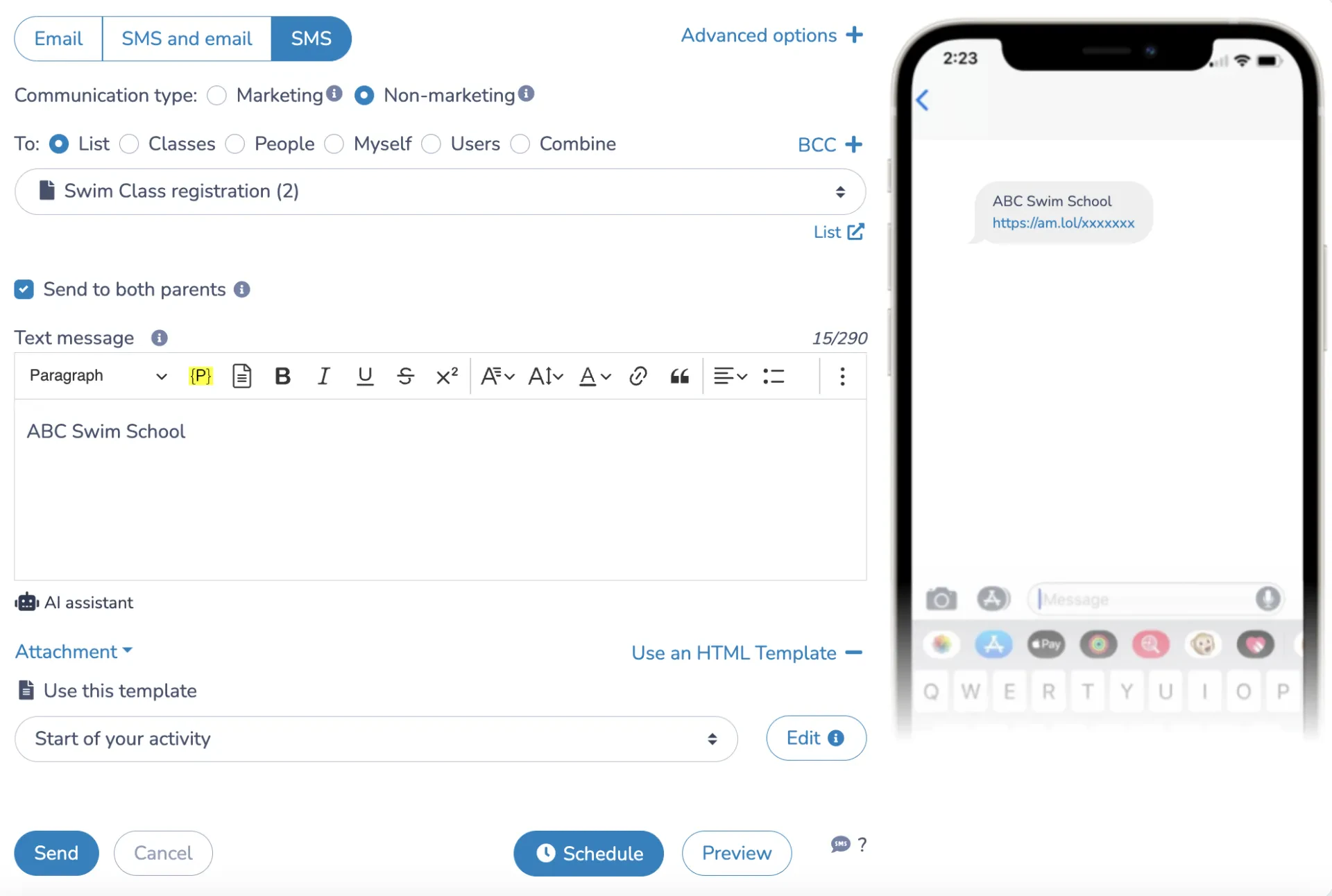
📌 Pro Tip: Keep texts short, warm, and action-oriented. One clear message, one clear next step. Avoid sending more than 2-3 texts per month for marketing purposes, or parents will start opting out.
6. Improve the Online Registration Process
Your online registration form is where interest turns into enrolment. If the process is confusing, slow, or broken on mobile, families will abandon it and book somewhere else. Most won’t tell you why. They’ll just be gone.
Families today expect to register quickly from their phones, without needing to call anyone or wait for confirmation. If your form doesn’t meet that expectation, it doesn’t matter how good the rest of your marketing is.
What a strong registration process looks like:
- Mobile-first. Most parents are browsing on their phones during school pickup or while their kids are at an activity. Your swim registration form needs to work flawlessly on a small screen, with minimal typing and clear buttons.
- Conditional logic. Show parents only the fields that are relevant to their registration. A parent signing up a 4-year-old for beginner lessons shouldn’t have to scroll past questions about competitive swim programs. Cleaner forms get completed more often.
- Multiple payment options. Accept credit cards, bank transfers, and payment plans where possible. Removing payment friction is one of the fastest ways to reduce abandoned registrations.
- Immediate confirmation. Send a detailed confirmation email the moment someone registers. Include the session dates and times, what to bring, and any next steps. A clear confirmation reduces anxiety and the “did it go through?” phone calls.
- Integrated into your website. Keep the registration form on your own site rather than redirecting families to a third-party page. Staying on your site maintains trust and keeps your branding consistent throughout the process.
- Automated waitlist management. When a class fills up, automatically add families to a waitlist and notify them the moment a spot opens. A prompt, automated notification converts far better than a manual follow-up that happens days later.
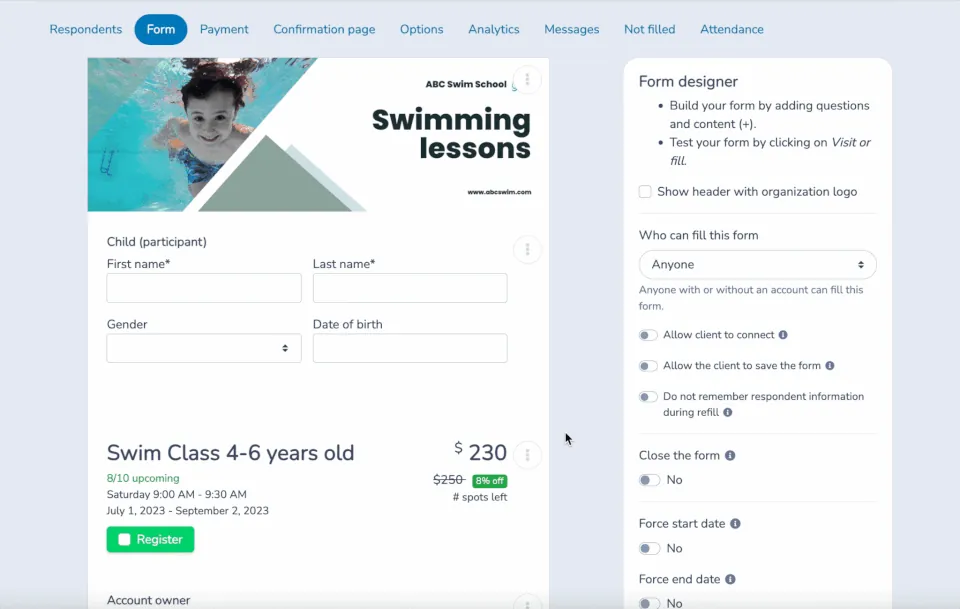
📌 Pro Tip: An unfriendly registration form is one of the most common reasons swim schools lose leads they’ve already paid to attract. If you’re spending money on ads or SEO, make sure the form those families land on is worth the effort it took to get them there.
7. AI (ChatGPT) for Marketing
AI writing tools have become genuine time-savers for swim school operators who know where to use them. The key is knowing where they actually help.
Writing program descriptions and promotional copy. This is where most operators see immediate value. Instead of staring at a blank page, give ChatGPT a prompt like: “Write a fun, parent-friendly description of a 6-week beginner swim lesson program for kids ages 3-5, emphasizing water safety and confidence-building.” You’ll get a solid draft in seconds that you can personalize with your school’s voice.
👉 Here’s a quick example of what that looks like in practice:
Without AI: “We offer beginner swim lessons for young children. Classes run for 6 weeks.”
With AI (then edited): “Our Little Splashers program helps children ages 3-5 discover the joy of the water in a safe, nurturing environment. Over 6 fun-filled weeks, your child will build water confidence, learn essential safety skills, and maybe even learn to love the pool, all with our certified instructors by their side.”
Photo editing. Use AI-powered photo-editing tools like Canva’s Magic Designer to effortlessly enhance your marketing visuals.
Email subject lines. Open rates often depend on the subject line. Tools like ChatGPT or CoSchedule’s Email Subject Tester can generate and score multiple options in seconds. Write two versions and see what your audience actually responds to.
Social media captions. Share your upcoming session details with an AI tool and ask it to write five caption variations: casual, urgent, fun, safety-focused, and testimonial-style. Pick the one that fits the moment.
🚩 Where to be careful: AI doesn’t know your community, your instructors, or what makes your school different. Always edit the output to include specific details such as instructor names, local references, and your school’s personality. Generic AI copy is easy to spot and easy to scroll past.
📌 Pro Tip: Start with one use case, program descriptions or email subject lines, and build from there. Ten minutes with ChatGPT can save you an hour of staring at a blank page.
8. Swim Lesson Surveys
An end-of-session survey for your swim school is one of the simplest ways to improve your programs and generate marketing material at the same time.
At Activity Messenger, we send an automated survey email 2-3 days before the last lesson of each session. That timing matters. Parents are still engaged, the experience is fresh, and you get honest feedback before they’ve moved on to the next thing.
What to do with the responses:
- Turn high scores into review requests. If a parent rated their experience a 4 or 5 out of 5, follow up personally and ask if they’d be willing to share it on Google or Facebook. Most say yes when you ask promptly and make it easy with a direct link.
- Use positive comments in your marketing. A sentence from a real parent carries more weight than anything you write about yourself. Pull standout responses into your email campaigns, registration page, and social ads.
- Act on the critical feedback. If multiple families flag the same issue, fix it and mention the improvement in your next session’s communications. Showing that you listen builds the kind of trust that keeps families coming back year after year.
- Include a progress certificate. A simple personalized certificate parents can print or share on social media celebrates their child’s progress and puts your school’s name in front of families who have never heard of you.
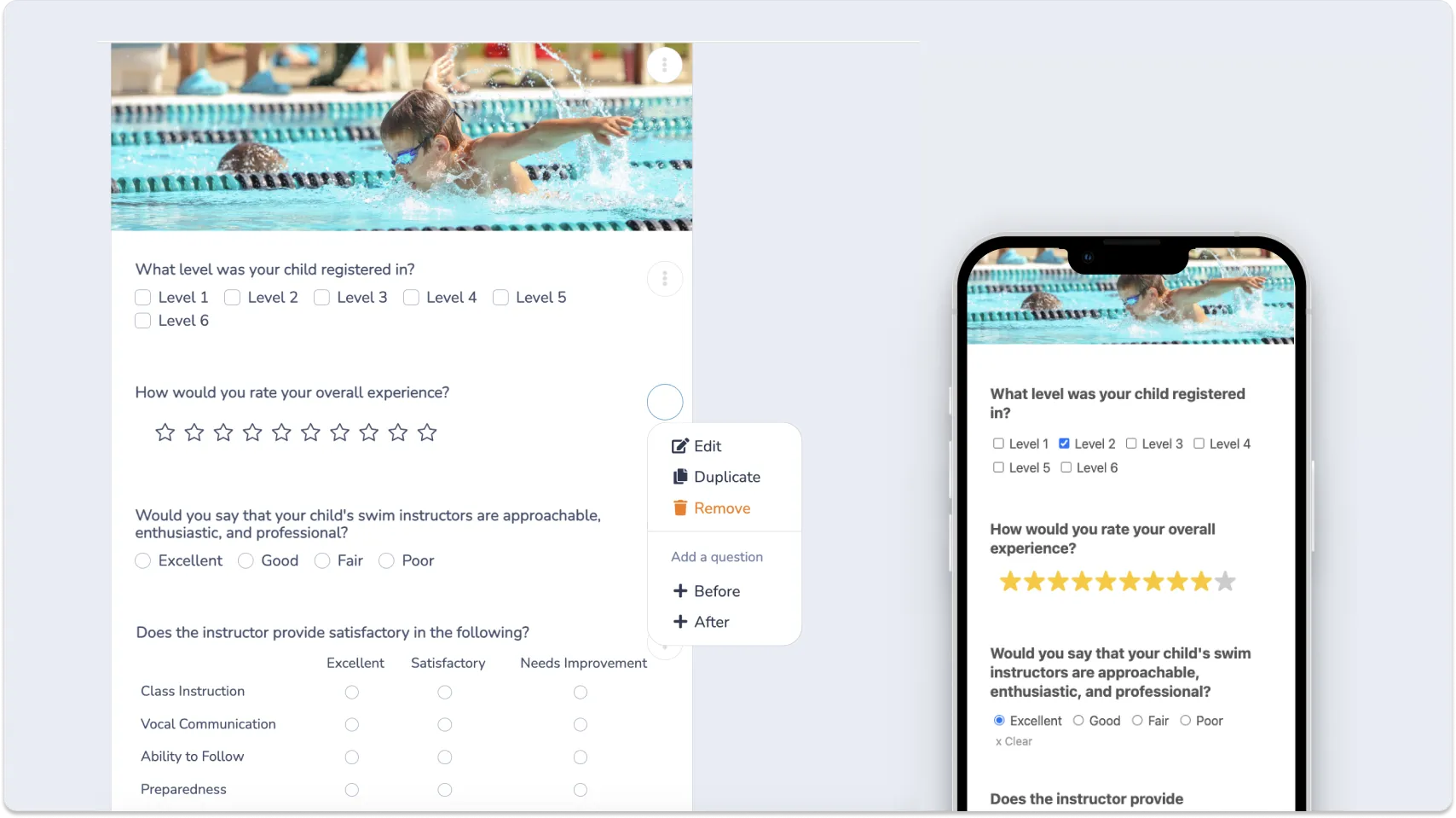
📌 Pro Tip: As an operator, collecting feedback used to be a tedious task that we often neglected. Now, with Activity Messenger, we’ve streamlined the process by sending automated messages as sessions end.
9. Customer Referrals
Referrals work because parents trust other parents more than they trust any ad you could run. A recommendation from a friend carries more weight than a polished Facebook campaign, and it costs you almost nothing to set up.
Most swim schools don’t have a referral program because building one feels complicated. It doesn’t have to be.
How to build a simple referral program:
- Make the incentive tangible. A discount on their next session, a credit toward merchandise, or a free class works far better than a vague thank-you. Even a $20 credit is enough to motivate a happy parent to mention your school to a friend.
- Give them something to share. Referral cards they can hand out in person or a personalized link they can text or post to a neighbourhood Facebook group removes the friction.
- Ask at the right moment. The best time to mention your referral program is in your post-session confirmation or end-of-session email, when the experience is fresh, and parents are already thinking about what comes next.
- Consider a two-sided reward. Rewarding both the referrer and the new family consistently outperforms one-sided programs and gives the new family an extra reason to actually book.
- Thank referrers personally. A brief note thanking a parent by name and letting them know their referral has signed up goes a long way. People refer again when they feel appreciated.
📌 Pro Tip: Most parents do two things before choosing a swim school: ask friends for recommendations and check online reviews. Your referral program handles the first. Your review strategy handles the second. Together, they’re your most cost-effective long-term marketing.
10. Post-Session Guest Conversion
Think about who’s watching from the bleachers during any given session: parents of kids in the water, grandparents dropping off, friends who came to a trial class or swim event. These people have already seen your instructors in action and formed a positive impression of your school without ever signing up.
Most swim schools let that moment pass without a follow-up.
How to set it up:
At the end of each session, whether it’s a group class, a trial lesson, or a swim event, collect contact information from non-enrolled attendees where possible. This could be through a guest sign-in at the pool deck, an RSVP for open house events, or waivers collected from trial participants.
Two to three days later, send an automated follow-up email that:
- Thanks them for being part of the session or event
- Highlights your upcoming programs with a brief description of what’s available
- Includes a first-timer discount or promotional code
- Links directly to your online registration page
A simple post-session email template:
Hi [Parent Name],
It was great having [Child Name] in the water with us. We hope they had a blast and came home a little more confident in the pool.
If you’re thinking about taking the next step, we’d love to have them join one of our upcoming sessions. As a thank-you for trying us out, here’s 15% off your first registration. Just use the code SPLASH15 at checkout.
[Register Here]
Hope to see you back at the pool soon.
This single automation, running in the background after every session, can consistently convert curious families into enrolled ones without any manual effort from your staff.
📌 Pro Tip: If you run open houses or family swim events, this is especially valuable. You’re already spending time and money bringing new families to your facility. The follow-up email is what turns that investment into actual registration.
11. SEO for Swim Schools
Most swim school families search for lessons within a few kilometres of home or their child’s school. That’s what makes local SEO one of the highest-return long-term investments you can make. You’re not competing with every swim school in the country, just the handful in your area, and a well-optimized online presence can put you consistently at the top of local search results.
Start with your Google Business Profile. This is the fastest win for most swim schools. Claim your listing, fill it out completely with photos of your facility and classes, accurate hours, a description that mentions your city and programs, and answers to common questions in the FAQ section. Schools with complete, active profiles rank significantly higher in local map results.
Use the right keywords on your website. Think about what a parent actually types when they’re looking for you: “swim lessons for toddlers in [city],” “kids swim school near [neighbourhood],” “adult beginner swim lessons [city name].” These specific, location-based phrases are much easier to rank for than broad terms like “swim lessons,” and they attract families who are already close to making a decision.
Build a dedicated page for each program. A single homepage can’t rank well for six different programs. A dedicated page for toddler swim lessons, one for adult lessons, and one for competitive training gives each program a real chance to surface in search and gives parents exactly the information they came for.
Create content that answers real questions. A short blog post titled “How to Choose a Swim School in [City Name]” or “What Age Should My Child Start Swim Lessons?” does two things: it ranks for questions parents are already searching, and it positions your school as a trusted local resource before a family has ever visited your pool.
Build local backlinks. Getting linked to by local parent blogs, community directories, or school newsletters tells Google that your school is a recognized part of the local community. These links carry real weight in local rankings and are often easier to earn than you’d think. A note to a local family blogger or a sponsorship of a community event can do it.
📌 Pro Tip: Focus on long-tail keywords and local search terms to quickly improve your ranking before your site builds more authority on Google. Here is our complete SEO guide to increase your swim school rankings on Google and ChatGPT.
12. Pay Per Click (PPC) Ads
Pay-per-click (PPC) advertising is a method where you pay each time someone clicks on one of your online ads. For swim schools, this typically means appearing at the top of Google search results when a parent types something like “kids swim lessons near me” or “swim school in [city].”
It’s one of the fastest ways to get in front of families who are actively looking, rather than waiting for them to stumble across you organically.
Running a PPC Campaign for Your Swim School:
- Keyword research. Start by identifying the phrases families actually use when searching for swim lessons in your area. Focus on location-specific terms like “toddler swim lessons [city]” or “adult beginner swim classes near me” rather than broad terms that attract clicks from outside your catchment area.
- Ad creation. Write ads that speak to what makes your school worth choosing: your instructors, your safety record, your teaching approach, or a current promotion. A specific, honest ad will outperform a generic one every time.
- Monitor and adjust. Check your campaign performance regularly. If certain keywords are driving clicks but not registrations, pause them and shift budget toward what’s working.
Why PPC works well for swim schools:
- Immediate visibility. Unlike SEO, which builds over time, a PPC campaign can put you in front of local families the same day you launch it. This makes it especially useful for newer schools or for sessions that need to fill quickly.
- Controlled budget. You set the daily limit and only pay when someone actually clicks. There’s no minimum spend, so you can start small, see what works, and scale from there.
- Measurable results. Every click, conversion, and dollar spent is tracked. You always know exactly what your advertising budget is doing.
📌 Pro Tip: PPC works best when it sends families to a dedicated landing page for the specific program they searched for, not just your homepage. A parent who clicks on “toddler swim lessons” should land on a page about toddler swim lessons, with a clear registration link and no distractions.
Where to Start
Based on what consistently drives enrolment for swim schools, here’s where to focus your efforts first:
- Email segmentation. Separate your past, current, and potential clients so each group gets communication that’s actually relevant to them. This alone will improve open rates and cut unsubscribes almost immediately.
- Early-bird registration. Open your next session earlier than you think you need to, pair it with a time-limited discount, and watch how it changes your cash flow and staffing structure.
- A clean online registration form. If your booking process has friction, everything else on this list is working against itself. Fix this before you spend money on ads.
Once those three are running, layer in SMS, referrals, and local SEO. Then add post-session conversion emails and PPC when you’re ready to scale.
The swim schools that consistently fill their rosters aren’t always doing the most marketing. They’re doing the right things consistently, with enough automation in place that their staff can focus on what actually matters: teaching kids to swim.
Streamline Your Swim School With Activity Messenger
If the strategies above sound like a lot to manage manually, that’s because they are.
Every strategy in this article requires some version of email, forms, payments, reminders, or follow-ups. Managing all of that across separate tools is where most swim schools lose time, miss follow-ups, and leave enrolment on the table.
Activity Messenger is built specifically for swim schools and children’s activity programs.
Here’s what it handles:
- 📧 Segmented email marketing — send the right message to past participants, current families, and potential new customers without overlap
- 🐣 Session registration with early-bird pricing — built-in discount logic, automated waitlists, and payment processing
- 📱 SMS marketing — class reminders, cancellation alerts, and promotional messages with CASL and TCPA compliance built in
- 📝 Mobile-friendly forms — conditional logic, digital waivers, deposit collection, and automated balance reminders
- ⭐ Post-session survey and review automation — automatically collect feedback and guide happy families toward leaving a Google or Facebook review
- 🔁 Post-session guest conversion — automated follow-up emails that turn trial participants and event guests into enrolled families
It can also replace tools you may already be paying for separately, including Jackrabbit, iClassPro, Jotform, SurveyMonkey, SmartWaiver, and Mailchimp.
📅 Book a free demo here, and we’ll show you how other swim schools are using Activity Messenger to fill their rosters without adding work for their staff.
3. Social Media Marketing
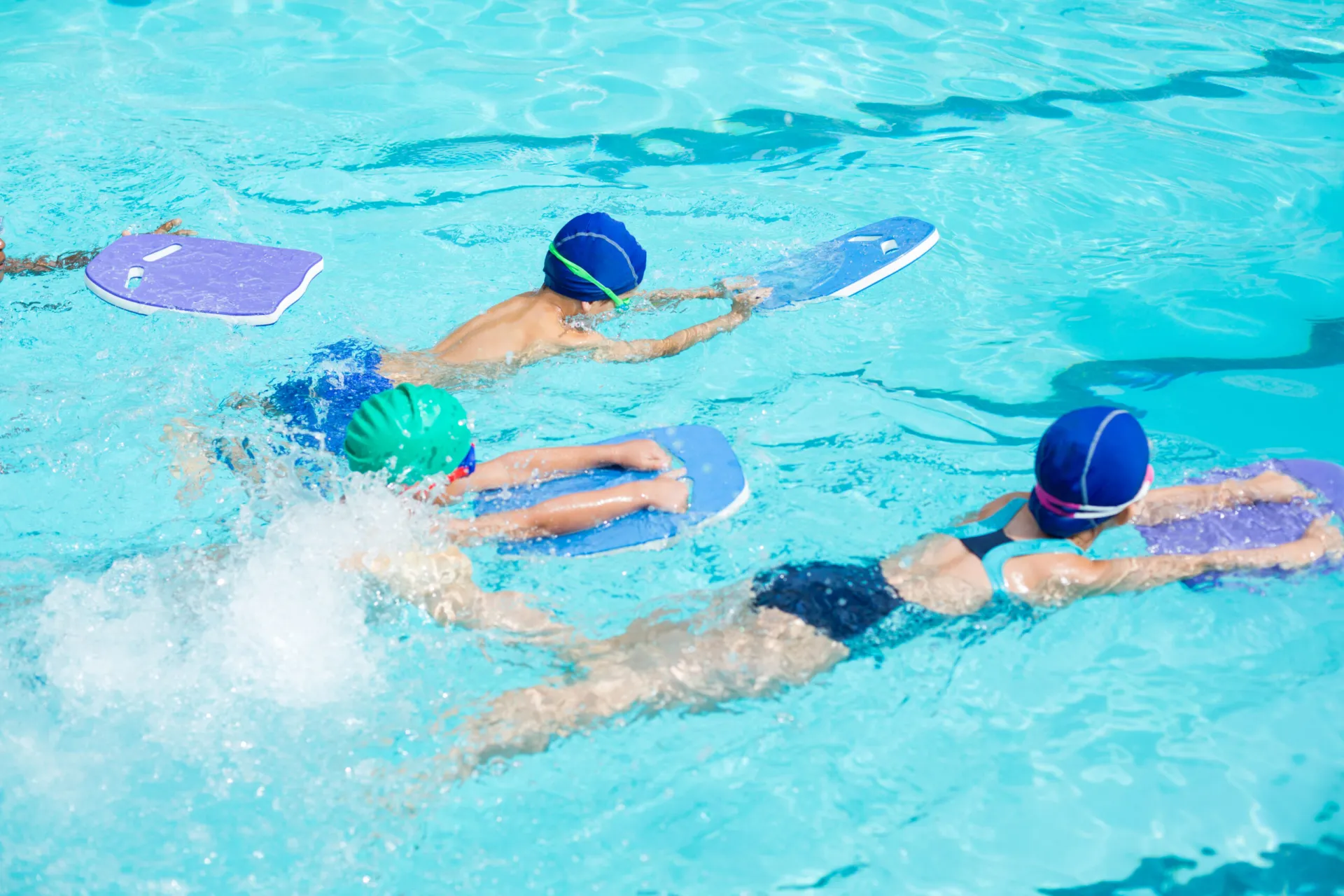
Social media is one of the most cost-effective ways to fill spots in your swim programs, and you don’t need to be posting every day for it to work.
Advertising on Facebook and Instagram puts your school in front of local families who may never have heard of you. Even a small daily budget can drive meaningful traffic to your registration page, and because you can target by location, you’re not wasting spend on people who live 40 minutes away.
My approach is to create one set of ads per session rather than trying to manage a constant stream of content. It’s less time-consuming, easier to track, and tends to produce better results. Design an image or video ad in Canva, target it within a few kilometres of your pool, set a modest daily budget, and let it run.
What performs well on social media for swim schools:
A few things worth knowing about paid social: