Municipal newsletters are one of the most effective ways to communicate with residents. From promoting local events and programs to sharing emergency updates and municipal decisions, effective newsletters help build transparency, trust, and engagement within your community.
This guide walks you through everything your municipality or small town needs to know: how to build a compliant email list, what content actually gets read, how to choose the right platform, and how to avoid the mistakes that reduce open rates and erode resident trust.
Key Takeaways:
- Municipal newsletters help local governments communicate important updates, events, programs, and public notices more effectively.
- Building a compliant email list with clear resident consent is essential for meeting CASL and CAN-SPAM requirements.
- The best municipal newsletter platforms include features like segmentation, scheduling, analytics, and integration with recreation or registration software.
- Residents are more likely to engage with newsletters that contain relevant, concise, and easy-to-scan content.
- A consistent sending schedule improves open rates and helps residents know when to expect updates.
- Mobile-friendly layouts and simple formatting are important since many residents read newsletters on smartphones.
- Tracking metrics such as open rates, click-through rates, and unsubscribes helps municipalities improve communication over time.
Table of Contents
- Step 1: Build A Compliant Email List
- Step 2: Choose the Right Email Platform for Municipal Newsletters
- Step 3: Plan Content Residents Actually Want to Read
- Step 4: Set a Consistent Sending Schedule
- Step 5: Design for Mobile and Simplicity
- Municipal Newsletter Examples and Templates
- Platform Comparison: Which Tool is Right for Your Municipality?
- Frequently Asked Questions: Municipal Newsletters
- Final Thoughts
Step 1: Build A Compliant Email List
Before you send a single message, you need a list of residents who have genuinely asked to hear from you. In Canada, it’s required under CASL (Canada’s Anti-Spam Legislation). In the United States, CAN-SPAM sets similar ground rules.
How to grow your list:
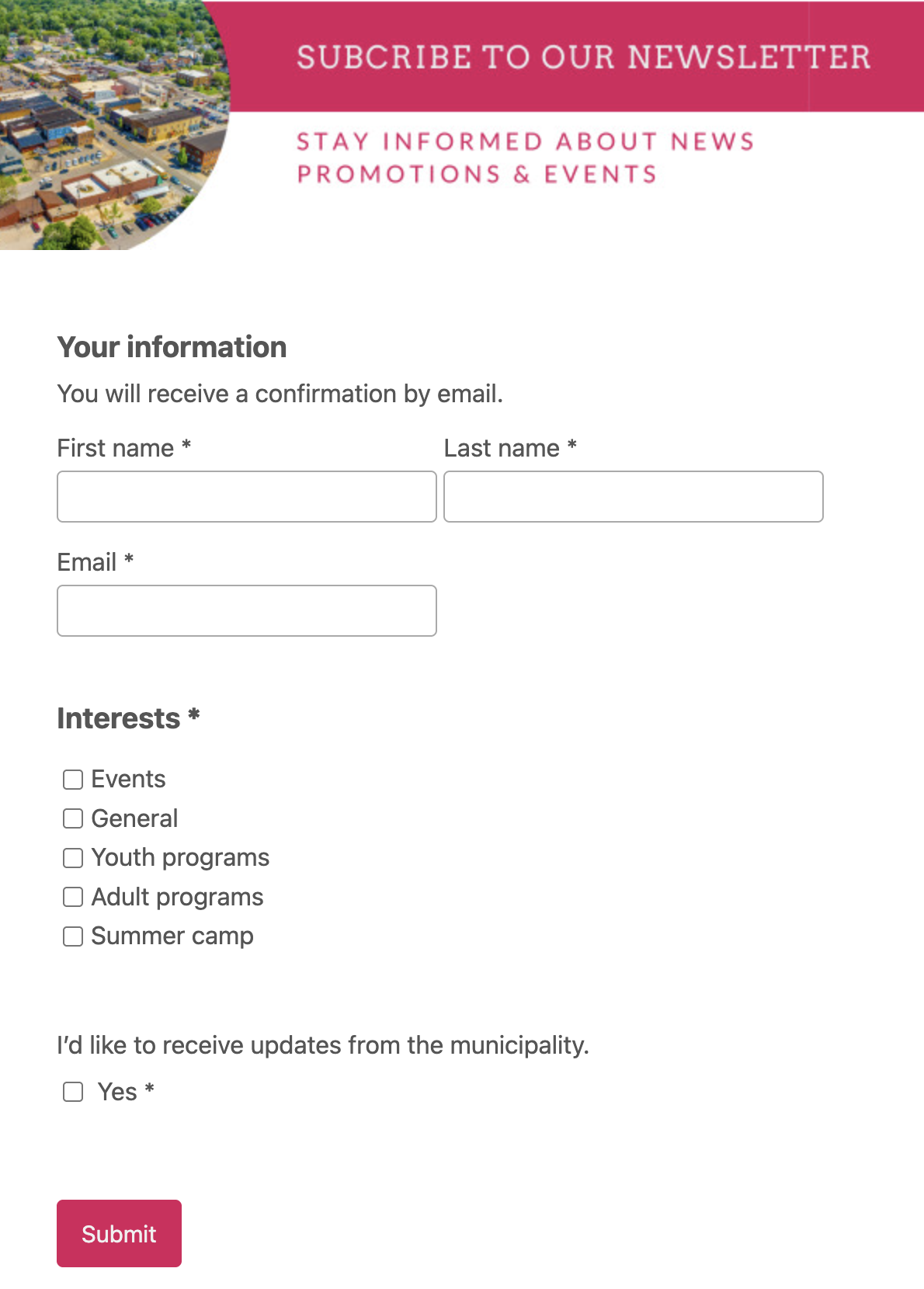
- Website opt-in form: Place a signup form prominently on your municipality’s homepage and key service pages. Make the value proposition clear: “Get emergency alerts, event updates, and program news delivered to your inbox.”
- Recreation and program registrations: Add an opt-in checkbox when residents register for camps, classes, or community events. The language should be clear: “I’d like to receive updates from the municipality.”
- Town halls and public events: Collect emails at the door with a paper sign-in sheet or a tablet with a simple form.
- Utility bills and tax notices: Include a QR code or short URL pointing to your signup page.
- Social media: Promote your newsletter through your existing channels with a clear reason to subscribe.
Compliance checklist:
- Never add residents without their explicit permission
- Include an unsubscribe link in every single email
- Store consent timestamps and the method used (e.g., “opted in via website form on March 3, 2026”)
- For lists that haven’t been contacted in 12+ months, reconfirm consent before resuming sends
Step 2: Choose the Right Email Platform for Municipal Newsletters
A general-purpose email marketing tool built for e-commerce will lack features municipalities actually need. Here’s what to look for when evaluating platforms:
- Drag-and-drop editor — your communications coordinator shouldn’t need IT support to build a newsletter
- List segmentation — the ability to send targeted messages by neighbourhood, language, or interest
- Scheduling and automation — write your newsletter in advance and queue it for Tuesday morning without being at your desk
- Analytics — open rates, click-through rates, and unsubscribe trends so you can improve over time
- Contact syncing — integration with your recreation management or registration software to keep lists current
- Compliance tools — built-in unsubscribe handling and consent logging; non-negotiable for CASL and CAN-SPAM
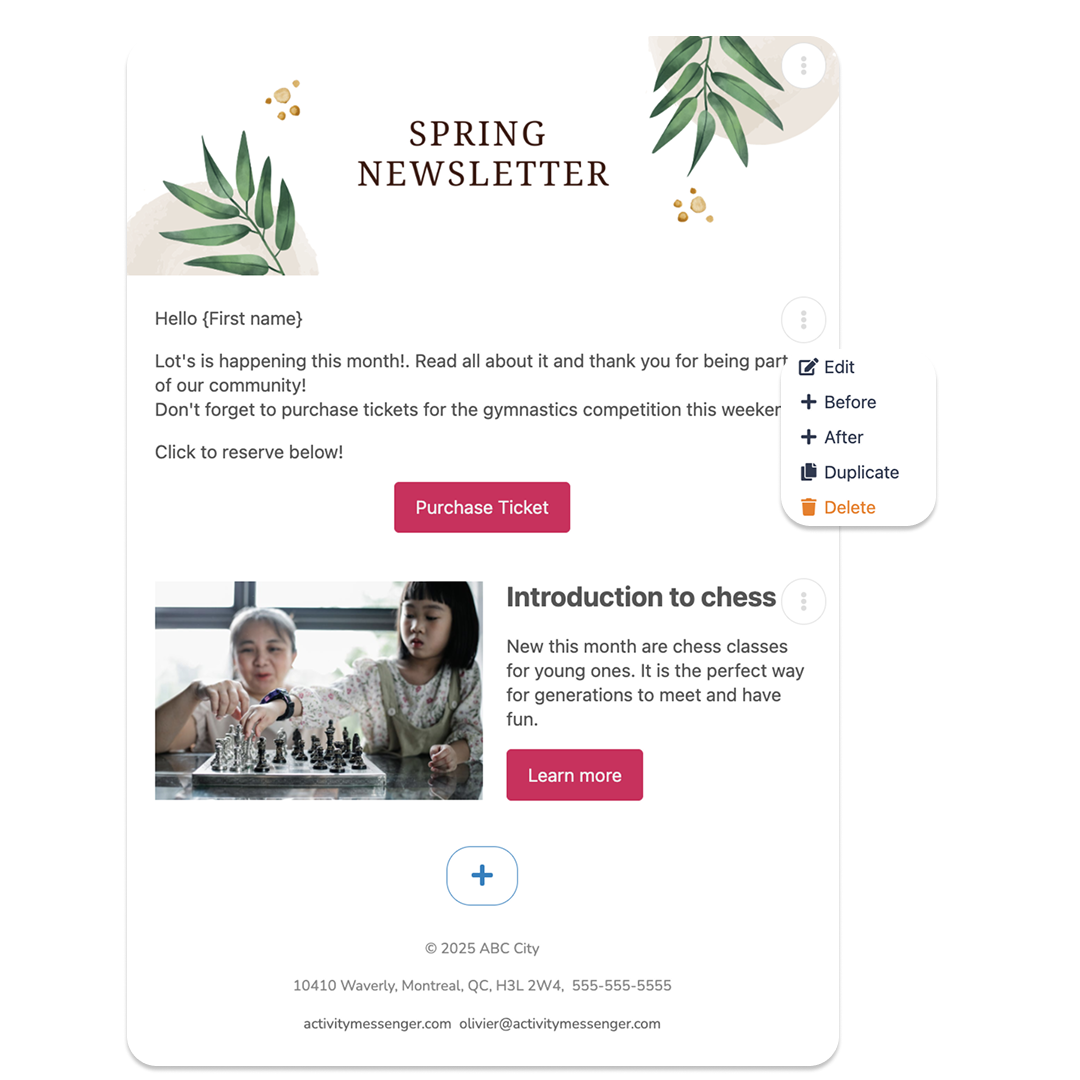
🏛️ Activity Messenger is a complete parks and recreation software solution, designed to help manage activities, surveys, facilities, memberships, and communications for your municipality or small town. See how we use email marketing to streamline communications, or book a demo for a personalized walkthrough.
Step 3: Plan Content Residents Actually Want to Read
The most common reason residents unsubscribe from municipal newsletters is irrelevance. Every issue should give your community a reason to stay subscribed.
Content types that consistently perform well:
- Upcoming events: Community festivals, public consultations, movie nights in the park, library programming
- Important deadlines: Property tax due dates, permit renewals, dog license expirations, program registration windows
- Public notices: Road closures, construction timelines, council decisions, zoning changes
- Program highlights: New recreation classes, senior services, youth programs, facility updates
- Emergency and service alerts: Boil water advisories, weather warnings, unplanned utility disruptions
- Community spotlights: Feature a local volunteer, a small business, or a community organization doing good work
- Calls to action: Link to a community survey, a feedback portal, or an upcoming public meeting registration page
👉 Each section of your newsletter should cover one topic and link out to your website for the full story. Long newsletters get skimmed; short, well-organized ones get read.
Step 4: Set a Consistent Sending Schedule
Consistency matters more than frequency. Residents who know to expect your newsletter on the first Tuesday of every month are more likely to open it than those who receive random sends with no pattern.
Suggested schedules by municipality size:
- Small towns (under 10,000 residents): Monthly — a roundup of everything coming up in the next four weeks
- Mid-sized municipalities: Bi-weekly — useful when there’s a steady volume of events and deadlines
- Larger cities: Weekly — shorter emails with more time-sensitive updates
Avoid over-sending. If you’re unsure, start monthly and adjust based on feedback and engagement.
When to send outside your regular schedule:
- Emergency or weather-related alerts (consider pairing with bulk SMS)
- Last-minute cancellations to registered program participants
- Major announcements: budget decisions, election results, significant infrastructure news
Step 5: Design for Mobile and Simplicity
Up to 60% of emails are read on a smartphone. A newsletter that looks polished on a desktop but breaks on mobile will lose a significant portion of your audience before they read a word.
Design best practices:
- Single-column layout — loads cleanly on any screen size
- Clear section headings — let readers scan and jump to what matters to them
- Short paragraphs — no wall-of-text blocks; three to four sentences per section is a useful guide
- One call to action per section — “Register Now,” “View the Agenda,” and “Read More” are clear and direct
- Your municipality’s branding — consistent logo placement, colour palette, and tone builds recognition over time
- Accessible design — sufficient colour contrast, readable font sizes (minimum 14px body text), and alt text on every image
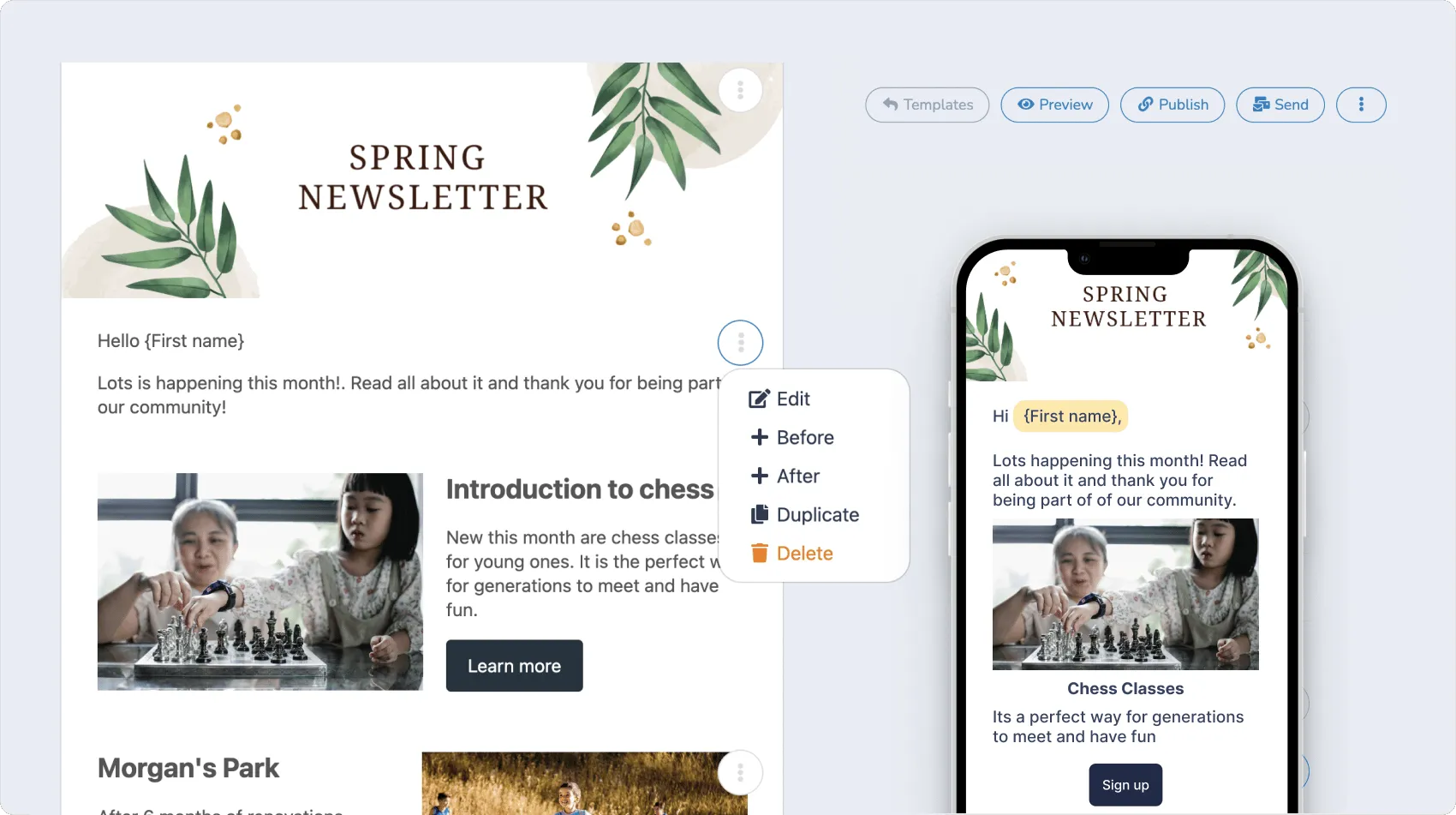
Municipal Newsletter Examples and Templates
Seeing what works is often more useful than reading about it. A strong municipal newsletter typically includes:
- A brief intro from the mayor or department head (2–3 sentences, not a formal letter)
- Three to five content sections, each with a heading, a short summary, and a link
- One featured event or program with a registration button
- A footer with your municipality’s contact information, social links, and unsubscribe option
If you already publish a printed bulletin, your newsletter doesn’t need to be rebuilt from scratch. Just convert that content into a digital format and add links and calls to action.
Example: A monthly newsletter for a small town might look like this:
📅 What’s On in Greenwood — May 2026
A quick update from your Parks & Recreation team.
Spring programs now open for registration Adult tennis, youth soccer, and senior fitness classes are now open. Spots fill fast — register before May 15. → Register Now
Road closure: Elm Street, May 20–27 Elm Street between 1st and 4th Ave will be closed for water main repairs. Use Oak Street as your alternate route. → View the detour map
Public consultation: New splash pad design We want your input on the proposed splash pad at Riverside Park. Join us May 28 at 6:30 PM at Town Hall, or fill out the online survey. → Take the survey
Questions? Contact us at | Unsubscribe
Platform Comparison: Which Tool is Right for Your Municipality?
| Activity Messenger | Mailchimp | Constant Contact | Brevo | |
|---|---|---|---|---|
| Pricing model | Flat rate | Per subscriber | Per subscriber | Per email volume |
| Built for municipalities | ✅ Yes | ❌ General use | Partial | ❌ General use |
| Registration integration | ✅ Yes | ❌ No | ❌ No | ❌ No |
| Surveys and waivers | ✅ Included | ⚠️ Add-on | ⚠️ Add-on | ⚠️ Add-on |
| Compliance tools | ✅ Built-in | ⚠️ Basic | ⚠️ Basic | ⚠️ Basic |
| Canva integration | ✅ Yes | ❌ No | ❌ No | ❌ No |
For municipalities managing recreation programs, facility bookings, and community events alongside their communications, an all-in-one platform significantly reduces administrative overhead compared to stitching together multiple tools.
💡 Activity Messenger is built specifically for this. Beyond email newsletters, a single subscription includes online registration, surveys, digital waivers, bulk SMS, and ticketing for community events, with flat-rate pricing that doesn’t climb as your contact list grows. There are no long-term contracts, and the interface is designed so your team can use it without IT support.
Frequently Asked Questions: Municipal Newsletters
How often should a municipality send a newsletter?
For most municipalities, monthly is the right starting point. It’s frequent enough to stay top of mind without overwhelming residents or your communications team. As your list and content volume grow, bi-weekly is a natural next step.
What should a municipal newsletter include?
At minimum, a strong municipal newsletter covers upcoming events, important deadlines, and public notices, with one clear call to action. The best issues also include a community spotlight and links to recent news on your municipal website.
Are municipal email newsletters required by law?
No, but the way you collect email addresses and send them is governed by law. In Canada, CASL requires explicit consent before sending. In the United States, CAN-SPAM sets rules around identification, opt-outs, and honest subject lines. Consult your municipal solicitor if you’re unsure how these apply to your communications.
What’s a good open rate for a municipal newsletter?
Government and public sector emails typically see open rates around 28.77%. If you’re consistently below 25%, it’s worth reviewing your subject lines, sending frequency, and list hygiene (removing addresses that haven’t engaged in 12+ months).
Can we use the same platform for email and SMS?
Some platforms, including Activity Messenger, handle both, which simplifies contact management and ensures residents who opt into multiple channels receive consistent messaging.
Final Thoughts
A municipal newsletter doesn’t need to be elaborate to be effective. It needs to be consistent, relevant, and easy to read. When residents receive useful information from their local government on a regular basis (without having to seek it out), they feel more connected to the community and more informed about the decisions that affect them.
Start with a clean list, a realistic sending schedule, and a handful of content categories that matter to your residents. Your residents are already on their phones, and a well-run newsletter meets them where they are.
Activity Messenger helps municipalities and small towns across North America send professional email newsletters, manage registrations, run surveys, and communicate by SMS, all from one platform.
📅 Book a free demo to see how Activity Messenger can simplify communications for your municipality or recreation department.
📖 Related Reading: