Activity Messenger Help Center
Invoices and client billing
There are several ways to bill customers, but generally, invoices are generated when someone registers through a registration form.
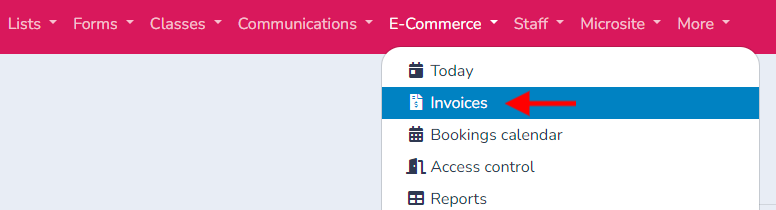
Go to the E-commerce tab and select Invoices. Here, you will see all the invoices on the platform.
You can also view invoices from a payment form through the Responses tab of the form. The invoices displayed will be limited to purchases made with that specific form.
Filter the invoices
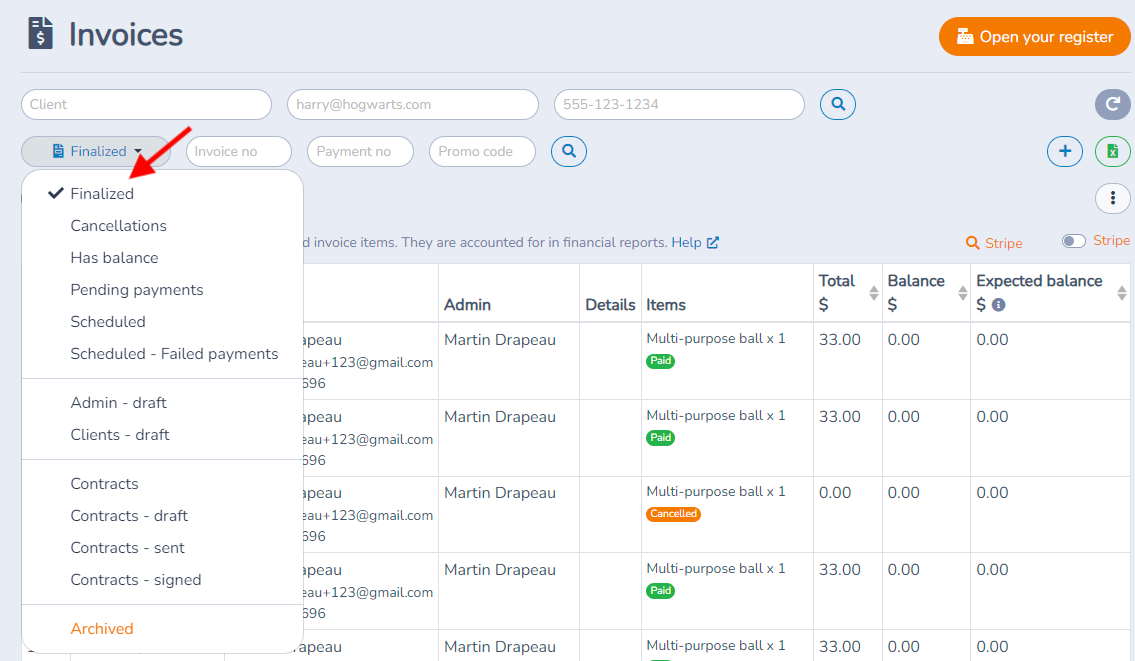
Use the menu at the top left of the list:
- Finalized: Indicates completed invoices.
- Cancellations: Lists invoices that have been created and then canceled.
- Refunded: Lists invoices that have been refunded.
- Has balance: Shows which invoices are unpaid.
- Invoicing workflow: Invoices that follow an invoicing workflow. This entry appears only if your organization uses invoicing workflows.
- Admin - draft: Invoices that are partially completed by an administrator and awaiting customer payment.
- Clients - draft: Invoices that are not yet finalized, often from abandoned payment forms.
- Draft - Payment received: Draft invoices for which a payment was already received.
- Contracts: Manage contracts, including drafts (Draft), sent (Sent) and signed (Signed) contracts.
- Archived: Invoices that have been archived by an administrator.
Use the Payment filter button for Pending payments (transactions awaiting payment confirmation, typically Interac e-Transfers), Scheduled payments (payment plans where payments are spaced over time) and Interac e-Transfer (by email). The To review button lists invoices that need your attention. For payments collected by pre-authorized debit batch, see Pre-authorized debit batches (AFT) in Canada.
Invoice
Click on a row to open the Client billing dialog. You are present with the client, form answers, purchased items, the invoice, payment(s) and messages relating to this purchase.
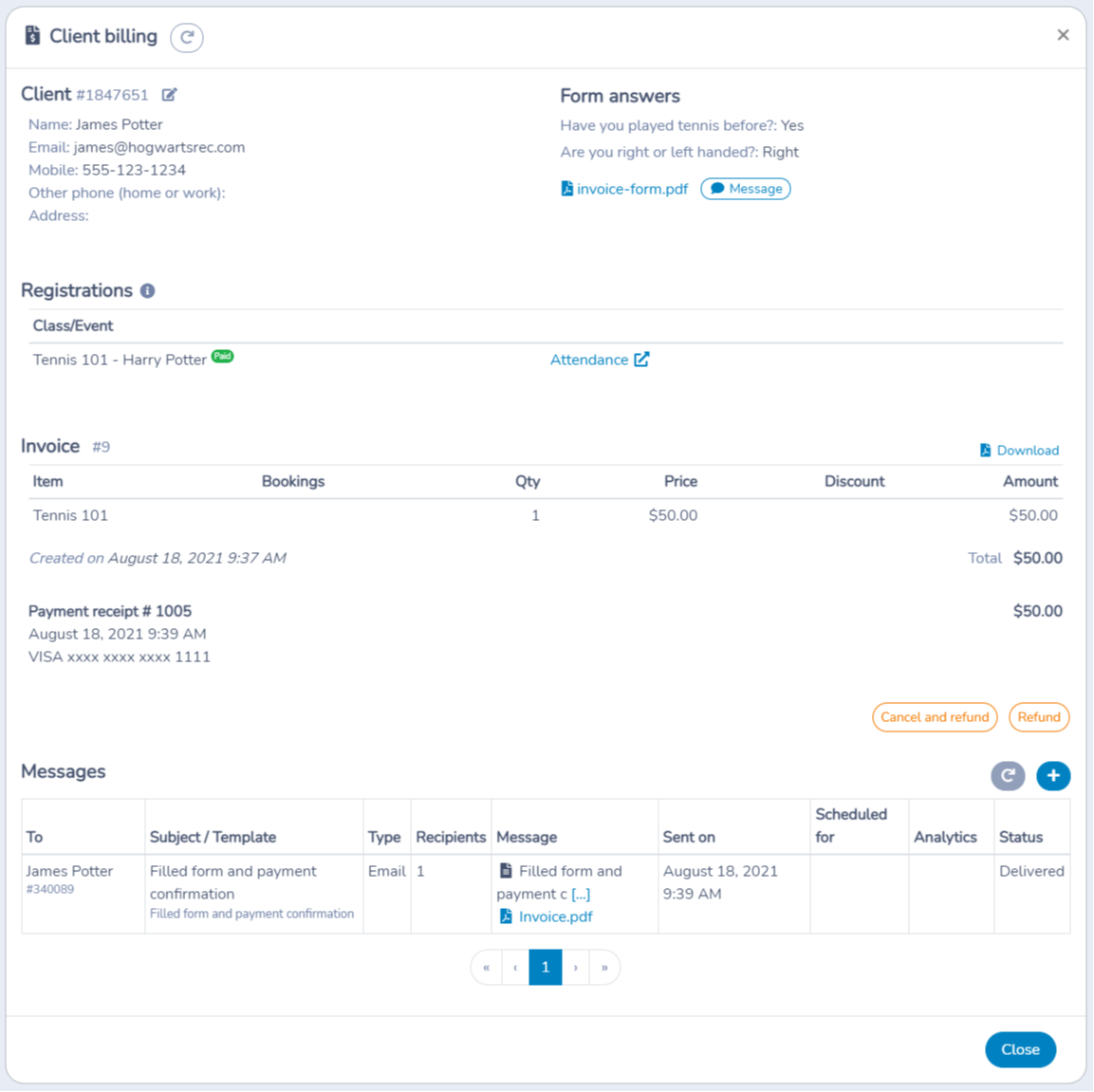
The customer billing window allows for the following actions:
- Edit the customer's name, email address, or mobile phone number.
- View and modify responses to form questions.
- Download the invoice in PDF format.
- Cancel purchases and specify the credit to apply.
- Credit items without cancelling their purchase.
- Refund a payment separately from its payment receipt.
- Enter a payment if there is a balance on the account.
- Resend the invoice to the customer via email.
- Send an email or text message to the customer.
- Add invoice items (custom items or course registrations).
Manage a client's credit card on file
An administrator can remove a client's saved Stripe card from the client account by opening any invoice that belongs to the client. This prevents Activity Messenger from using that card for future payments.
Before you begin
You need:
- Access to E-Commerce → Invoices.
- Permission to view client invoice details.
- A client with a Stripe credit card on file.
This guide is about a client's payment method. It does not change the credit card used to pay your organization's Activity Messenger subscription.
Remove the card
- Go to E-Commerce → Invoices.
- Open any invoice that belongs to the client.
- In the client section, find the saved card and click the edit icon beside it.
- In Payment methods on file, find Stripe credit card on file.
- Click Remove.
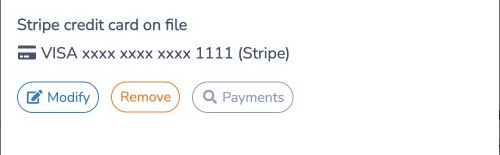
- Review the scheduled-payment warning, then click Remove to confirm.
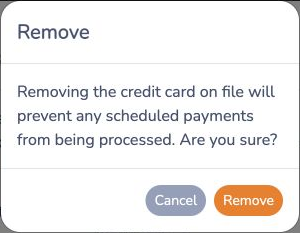
The card is removed from the client's account across your organization. The change is not limited to the invoice you opened.
Before removing a card with scheduled payments
Removing the card prevents scheduled payments from being processed with that card. It does not cancel scheduled-payment definitions, registrations, memberships, or other obligations.
Before confirming:
- Review the client's upcoming scheduled payments.
- Ask the client to replace the card when future payments should continue.
- Make any separate cancellation or payment-plan changes required by your agreement with the client.
What removal does not delete
Removing a card on file does not delete or change:
- Existing invoices.
- Completed payment and receipt records.
- Previous refunds.
- Registrations or memberships.
- Scheduled-payment definitions.
The Payments action beside the card remains useful before removal when you need to review payments associated with its brand and last four digits.
Can the client remove the card?
Clients can go to Invoices → Credit card on file in their client account to add or replace their card. They cannot remove it themselves. An administrator must use the invoice workflow described above.
Example
A family asks you to stop using its saved card after the current season. Open any invoice for that client, edit Payment methods on file, and remove the Stripe card. Existing invoices and receipts remain available, but future scheduled payments cannot use the removed card.
Related guide
Create a new invoice
Generally, invoices are created when a payment form has been filled out. It will remain in draft mode until the customer (or administrator) makes a payment, after which it will be finalized.
As an administrator, you can also create an invoice from scratch by clicking the (+) button. Choose an existing customer or add a new one. The newly finalized invoice will be added, and you can then add invoice items. Once it’s complete, you can send it to the customer for online payment.
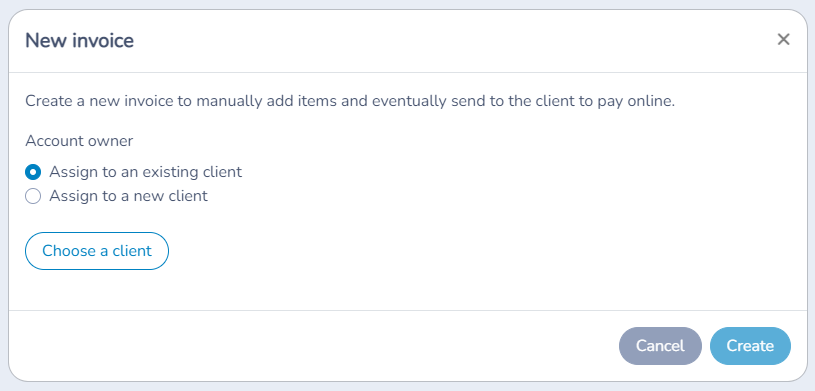
Adding new invoice items
Invoices can be added to even if they were paid. This will increase the total amount due and create a balance outstanding. The client can pay the balance online or you can take a payment offline.
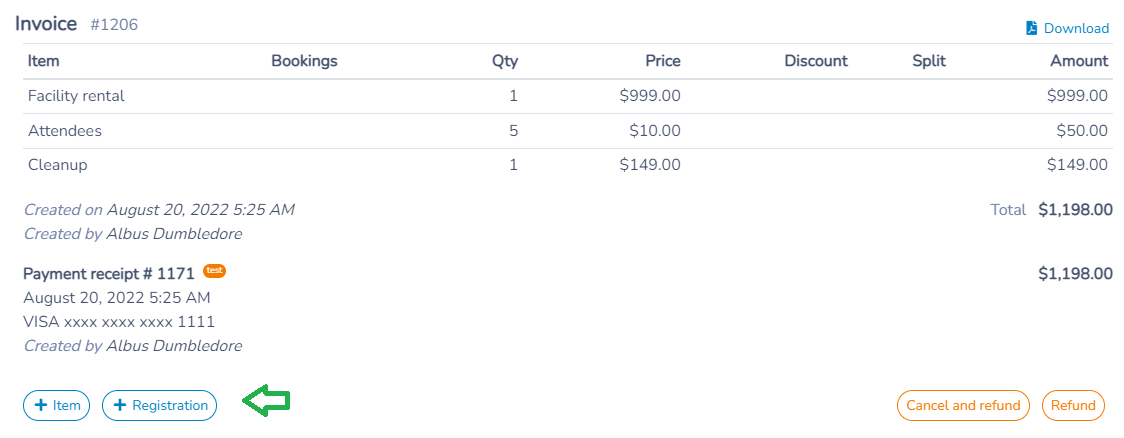
You can add a custom invoice item by entering the amount, quantity, sales taxes, and accounting code. This allows you to add fees or extras to an invoice. Unpaid custom invoice items can be modified or deleted.
To add an item, scroll to the bottom of the invoice and click on + Item, then select the type of item you want.
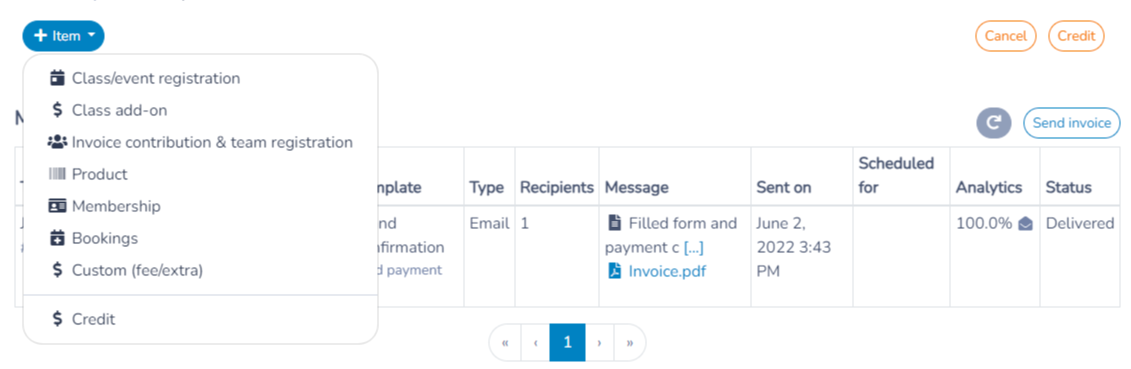
Types of Items
Item: Add an item to the invoice.
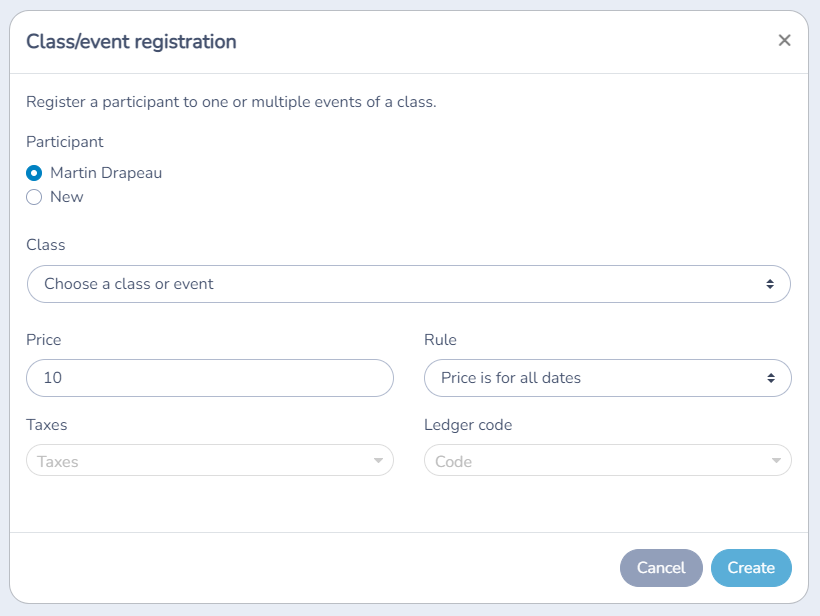
Class/event registration: Register the participant for an additional event.
Class add-on: Useful for adding services, such as childcare, if the client initially forgot to include it.
Membership add-on: Add an option to a membership.
Ticket: Add a ticket.
Team contribution: Allow someone to reduce the balance of an invoice by paying part of it.
Product: Add products like sports equipment.
Membership: Add or modify memberships.
Bookings: Add reservations for sports facilities. Shown when your organization uses bookings.
Player: Register a player on a team.
Custom (fee/extra): Add specific fees as needed, such as a late fee.
Default fee: Add your organization's default fee.
Credit: Add a credit to the invoice.
You can register someone to a class directly from the invoice. No need to pass through a payment form. Useful to manage private lessons and drop-ins.
See Create bulk invoices to bill several clients from one draft, register each included participant in a class or event, schedule installments, and exclude individual people.
Admin payment (offline)
The administrator can always take a payment offline. For example by cheque, by cash or a balance transfer from another platform. The administrator can also take a credit card payment by phone.
Click on the "Make a payment" button, and choose a payment method. You can also add a comment and send the receipt to the client by email.

Client payment (online)
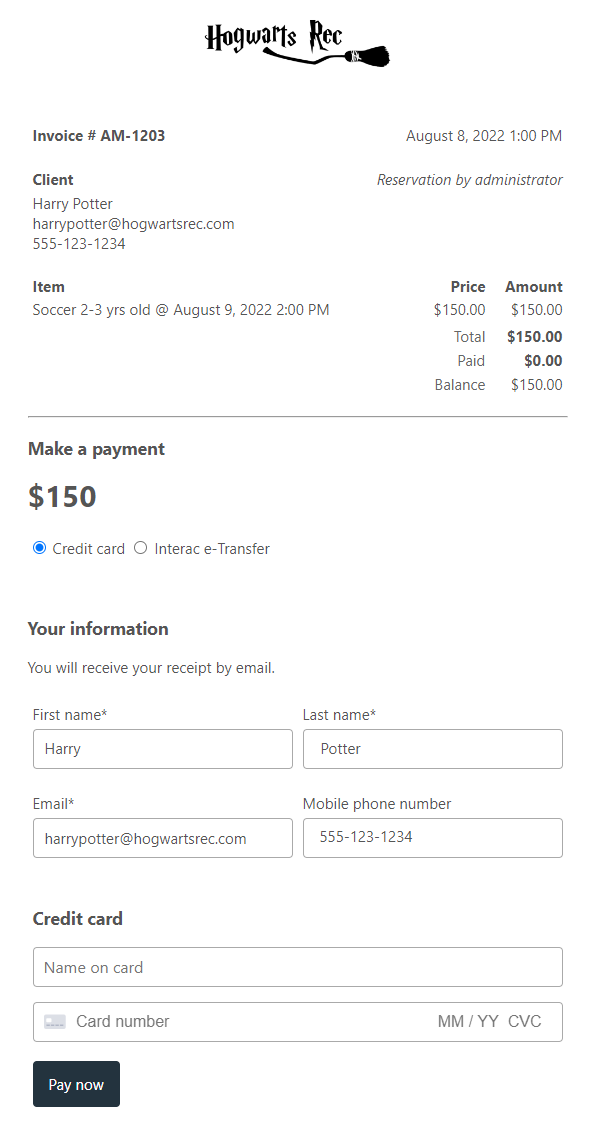
Any invoice with an outstanding balance can be sent to the client by email or by SMS for them to pay online with a credit card. In Canada, you can also allow the client to pay via an Interac e-Transfer payment.
Click on "Send a link to pay online" to open a New message window. The invoice PDF will be added as an attachment to the email. The client will receive a link that leads to a page to pay online.

The new message sending window will open. The invoice in PDF format will be attached to the email. The customer will also receive a link to pay the balance of their invoice online.
Request one payment for several invoices
Use an account statement when a client has several outstanding invoices and should pay the amount due with one card payment. Open the client account, select Billing → Invoices → Actions → Issue account statement, issue the statement, then send its link and optional email PDF.
After payment, each invoice has its own allocated payment receipt and a Paid from account statement ST-… link. The statement does not create another invoice. See the account-statement guide for payment breakdowns, historical PDFs, fees, refunds and reconciliation.
Cancellation, credit, and refund: choose the right operation
Cancelling an item, applying a credit, and returning money are related but distinct parts of invoice adjustments. The Cancel button opens the Cancel and credit window, which cancels the selected purchases and credits them; you refund the money afterwards. A standalone Credit keeps the purchase active. Create a refund, beside a payment receipt, is the separate step that returns the money.
For a step-by-step guide to each window, refunds by payment method and what a cancellation changes, see Refunds, credits and cancellations.
Before you begin
Go to E-Commerce → Invoices and open the client's invoice. Check the items, balance, payment receipts, and any previous credits or refunds. Your user permissions must allow the operation you want to perform; access to invoices alone does not grant permission to cancel, credit, or refund.
Cancel a purchase and retain a cancellation fee
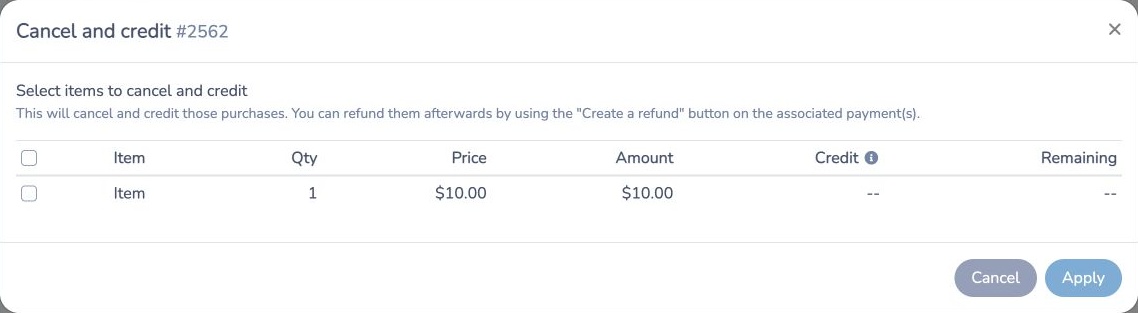
- Click Cancel below the invoice. The Cancel and credit window opens. It states: "This will cancel and credit those purchases. You can refund them afterwards by using the "Create a refund" button on the associated payment(s)."
- Select the items to cancel. When the window offers quantities or individual events, select only the quantities or events concerned.
- Review the Credit amount for each selected item. Check the remaining amount and taxes before applying.
- To retain an administrative/cancellation fee, credit less than the full amount of the item. For example, on a $100 item, credit $80 to keep $20. The $20 stays charged on the invoice.
- If a recurring-cancellation option appears, review whether future occurrences should also be cancelled.
- Add an administrator note if needed and choose whether to send the receipt by email.
- Click Apply. Then use Create a refund beside the payment receipt to return the money (see below).
For a fully paid $100 purchase with no taxes and a $20 fee, credit $80, then refund $80: $80 is returned and $20 is retained. If taxes apply, the credit is entered before taxes; check the remaining amount and taxes shown in the window and the invoice balance before applying.
There is no separate cancellation-fee field in this window. Do not deduct the same fee twice: reduce the credit once, then refund only the credited amount.
Refund a payment separately
- In the invoice, locate the original Payment receipt. Click Create a refund beside that receipt.
- Select the payment items and enter the amount to refund for each. Use the remaining refundable amount shown; account for previous refunds.
- Review the refund method. For a Stripe card refund, use the original card payment. This refunds that transaction, not an arbitrary card currently saved on the client's account.
- If you choose an offline method such as cash, cheque, or Interac e-Transfer, arrange the actual repayment separately. Recording that refund does not send cash, issue a cheque, or initiate an Interac e-Transfer. Other choices depend on your organization's configuration and the original payment.
- Add notes if needed, choose whether to email the receipt, then confirm the refund.
- Check the refund receipt and the invoice's updated balance. If the purchase was paid through several receipts, handle the relevant receipts separately.
A standalone payment refund does not by itself cancel a registration or credit the invoice items. If you refund a payment without cancelling or crediting the charge, the invoice can become payable again. Use the cancellation dialog when the purchase is ending, or Credit when reducing its price while keeping it active.
Credit an item while keeping the purchase active
To credit an invoice, your user needs the Can credit invoices permission. Account Owners always have it; Admins and Attendants have it only if an Account Owner has allowed it. Access to invoices alone is not enough, so if Credit does not work for you, ask an Account Owner to enable this permission for your user.
- Click Credit below the invoice.
- Select the items and enter the credit as a negative amount before taxes. Check the remaining amount, taxes, and balance shown.
- Choose whether to email the receipt, then click Apply.
The credit reduces the amount charged without cancelling the purchase or registration. It can reduce an unpaid balance or create a credit balance on a paid invoice. If you also need to return money, use Create a refund on the payment receipt as a separate step.
Examples
For simplicity, these examples have no sales taxes or other invoice items.
- Cancel a fully paid $100 registration: cancel it and refund $100. The registration ends and the final balance is zero.
- Cancel but retain $20: cancel the $100 registration with an $80 credit, then refund $80. The $20 retained remains charged.
- Give a $20 discount without cancelling: credit the paid $100 item by $20, then refund $20 if the client should receive the money back. The registration stays active.
- Cancel an unpaid $100 registration: cancel it with a $100 credit. There is no money to refund.
After an adjustment, review any remaining scheduled or pending payments and the expected balance. Cancellation can change these payments depending on the invoice; a refund is not a substitute for reviewing a payment plan.
Related help
Archiving invoices
Activity Messenger does not archive an invoice that has an impact on your finances. You cannot archive an invoice when any of its items has a payment recorded, or when one of its bookings is still active (cancel the bookings first). You need the permission to refund or modify payments.
To archive an invoice, open it and click on the Archive button located at the bottom left of the popup. Once archived it will be removed from the list of invoices.
If you need to, you can click on the filter and show archived invoices.
Invoice summaries for one client
To provide a combined record of selected invoices and their taxes, including invoices already paid, create an Invoice summary. Filter the Invoices page, select invoices billed to one client, then choose Actions → Create invoice summary. Review the selection and tax totals, choose the language, and create the document.
You can also use Billing → Invoices from the client account. The Documents tab keeps invoice summaries and account statements together, with PDF, Send and Logs actions. A summary is a saved record; it does not request payment or create another charge.
Settings reference
| Setting | Where | Default | Effect |
|---|---|---|---|
| Finalized / Cancellations / Refunded / Has balance | E-Commerce › Invoices › menu at the top left of the list | Finalized | Chooses which invoices the list shows: completed invoices, cancelled ones, refunded ones, or those with an unpaid balance. |
| Invoicing workflow | Same menu | Off; the entry appears only if your organization uses invoicing workflows | Shows invoices that follow an invoicing workflow. |
| Admin - draft / Clients - draft / Draft - Payment received | Same menu | Off | Shows invoices that are not finalized: started by an administrator, started by a client (often abandoned forms), or drafts where a payment was already received. |
| Contracts (Draft / Sent / Signed) | Same menu | Off | Lists contracts, optionally limited to draft, sent or signed ones. |
| Archived | Same menu | Off | Also shows archived invoices. Archived is shown in red. |
| Pending payments / Scheduled payments / Interac e-Transfer (by email) | E-Commerce › Invoices › Payment filter button | Off | Switches that narrow the list to invoices with a pending payment, scheduled payments, or an Interac e-Transfer. The Interac switch appears only when your organization has Interac e-Transfer set up. |
| Item, Payment, Forms, Tags, To review | E-Commerce › Invoices, filter buttons under the menu | Closed, no filter | Open extra filters by invoice item, payment type, form, tag, or invoices that need review. |
| New invoice | E-Commerce › Invoices, (+) button | Not applicable | Creates an invoice from scratch for an existing or new client. Not shown while a draft list is displayed. |
| Select invoices › Actions | E-Commerce › Invoices | Off | Lets you tick invoices and then Create invoice summary, Download invoice PDFs (ZIP), Apply credit, Message, Archive or Restore. Each action appears only if you have permission for it. |
| Download to Excel | E-Commerce › Invoices | Not applicable | Exports the invoices currently listed. |
| + Item | Bottom of an open invoice | Not applicable | Adds to the invoice, even if it is paid: Class/event registration, Class add-on, Membership add-on, Ticket, Team contribution, Product, Membership, Bookings, Player, Custom (fee/extra), Default fee or Credit. Some entries appear only when your organization uses the feature. |
| Make a payment | Open invoice | Shown when the balance is not zero | Records a payment taken offline. Reads Create a refund instead when the invoice has a credit balance. |
| Schedule payments | Open invoice | Shown when the invoice has an expected balance to schedule | Splits the balance into scheduled payments. |
| Cancel | Open invoice | Shown when at least one item is not yet cancelled | Opens Cancel and credit. Cancels the selected purchases and credits them; refund separately. |
| Credit | Open invoice | Not applicable | Reduces an item's amount while keeping the purchase. Needs Can credit invoices. |
| Create a refund | Beside a payment receipt in an open invoice | Shown when the payment has a refundable amount | Refunds that payment separately. Needs Can refund. |
| Send a link to pay online | Open invoice | Shown when there is a balance due | Opens a message with the invoice PDF and a payment link. |
| Archive | Bottom left of an open invoice | Not archived | Removes the invoice from the list. Refused when any item has a payment recorded or a booking is still active. Needs permission to refund or modify payments. |
| Payment methods on file › Stripe credit card on file › Remove | Open invoice › client section › edit icon beside the saved card | Not applicable | Removes the client's saved Stripe card across your organization. Invoices, receipts and refunds are kept. |
| Can credit invoices / Can cancel invoices / Can refund | Organization settings › Users & permissions › staff user | Off, except Account Owners who always have them | Controls who may use Credit, cancel items without refund, and issue refunds or adjust payments. |
Common questions
Where do I find all invoices for a client or a form? Go to E-Commerce › Invoices and search by client, or open the form's Respondents tab to see only the invoices from that form. Use the menu at the top left to switch between finalized, cancelled, refunded and draft invoices. See Filter the invoices.
Why can't I credit, cancel or refund an invoice? Access to invoices is not enough: Credit, cancelling items without refund and refunds each need their own permission (Can credit invoices, Can cancel invoices, Can refund). Account Owners always have them; other staff only if an Account Owner enables them in Users & permissions. See Credit an item while keeping the purchase active and Users and permissions.
How do I cancel a registration but keep part of the money? Cancel and credit the item for less than its full amount, then refund only that credited amount from the payment receipt. For a $100 item, credit $80 and refund $80 to keep $20. See Refunds, credits and cancellations.
Why does the button say Create a refund instead of Make a payment? The invoice has a credit balance (the client has paid more than is owed), so the button offers a refund instead of a payment. When the balance is zero, the button is not shown.
Can I archive a paid invoice? No. Archiving is refused when any item of the invoice has a payment recorded, or when a booking on it is still active. See Archiving invoices.
How do I add something to an invoice that is already paid? Open the invoice, click + Item and choose the type. The total increases and a balance is created, which the client can pay online or you can take offline. See Adding new invoice items.
How do I send an unpaid invoice to the client? Open the invoice and click Send a link to pay online. The message includes the invoice PDF and a link to pay the balance. For several invoices at once, see Account statements. See Client payment (online).
Where are the Interac e-Transfers that are still pending? In E-Commerce › Invoices, open the Payment filter and switch on Pending payments and Interac e-Transfer (by email). See Interac e-Transfer.